Why I am Building Evidra.ai: The Career Evidence Problem Nobody Tracks
Why career growth should start with evidence, not generic AI content
Introduction: Your Best Career Stories Are Probably Lost
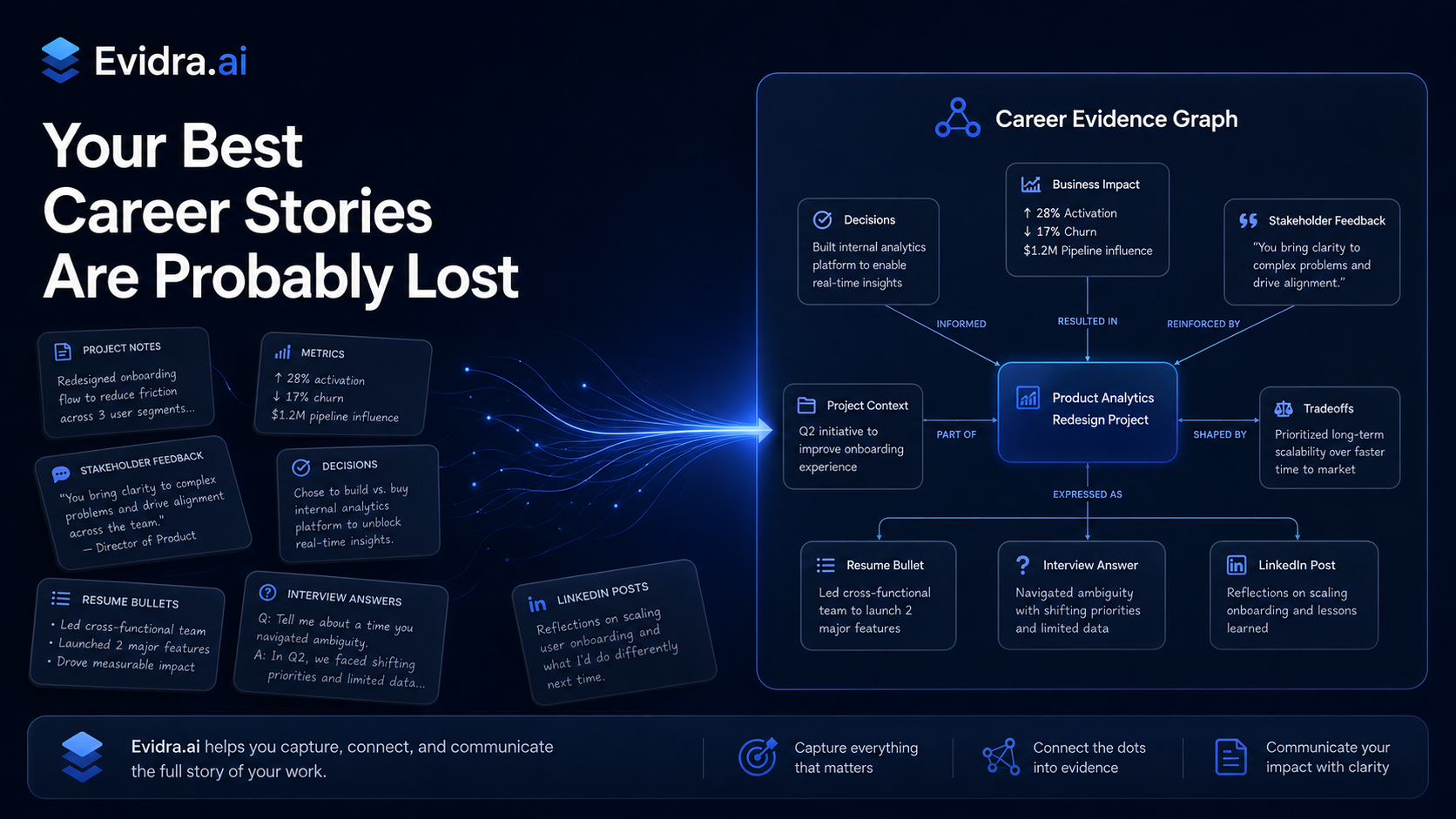
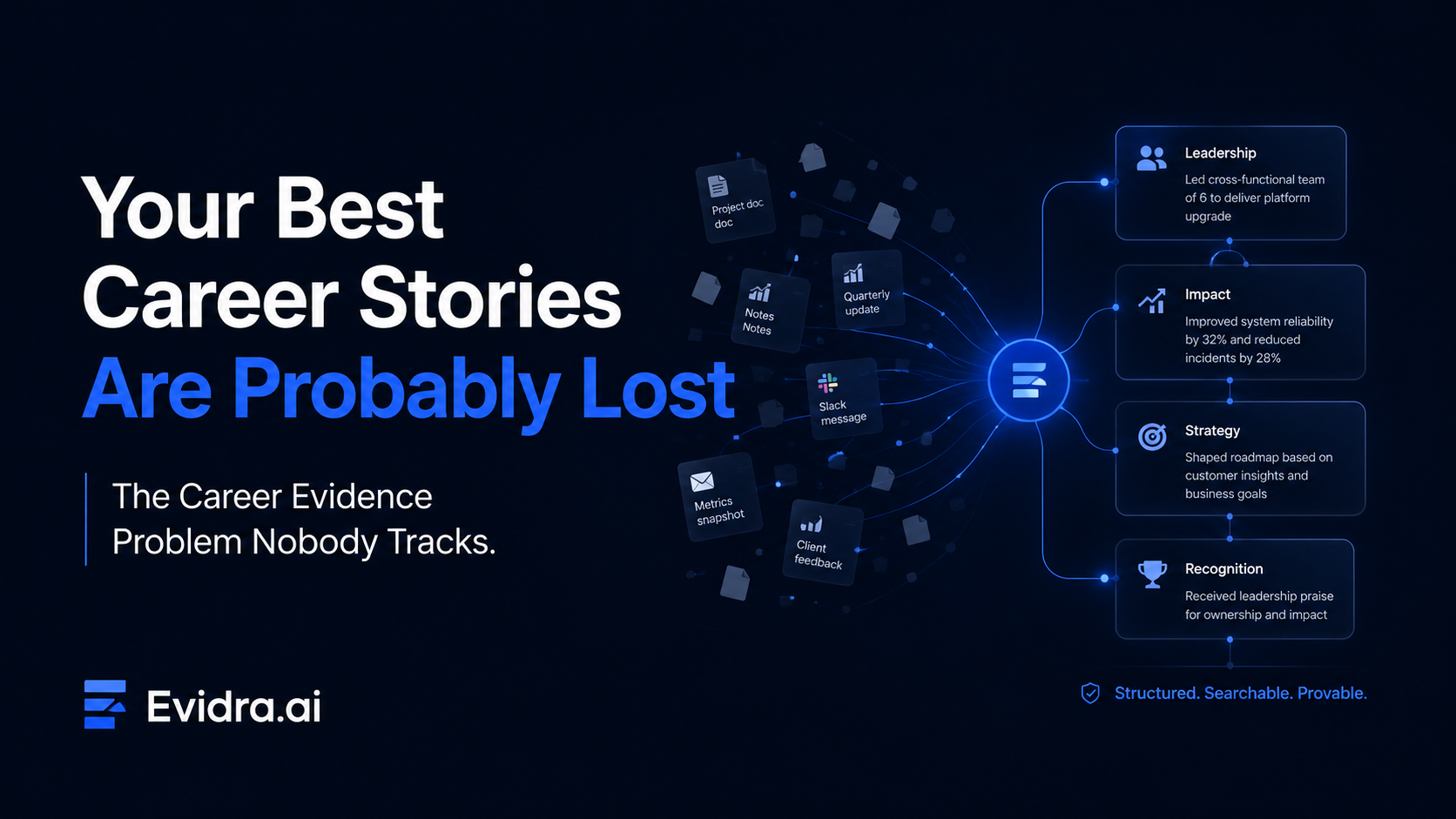
Your best career stories are probably lost.
Not because the work was small.
Because the proof was never captured as a product asset.
Most professionals do meaningful work every week. They ship projects, influence decisions, solve messy problems, improve metrics, handle tradeoffs, and earn stakeholder trust. But when an opportunity arrives, the proof behind that work is scattered across resumes, notes, dashboards, old documents, feedback threads, memory, and half-remembered project details.
Then the pressure moment comes.
A recruiter asks, “Tell me about your impact.”
A hiring manager asks, “Walk me through a difficult product decision.”
A promotion discussion asks, “What changed because of your work?”
And suddenly, the person is not preparing from evidence. They are reconstructing from memory.
That is the problem I am building Evidra.ai around.
The early product framing is simple:
- Real work happens.
- Evidence gets scattered.
- Opportunity arrives.
- The story comes out weaker than the work.
Evidra.ai is my attempt to build from that missing layer: structured career evidence.
Not another generic AI answer generator.
Not a polished resume wrapper.
Not a tool that helps people fake competence in real time.
The product direction is evidence-first: help professionals turn real work into career evidence, then use that evidence to build stories, prep kits, recruiter signals, and opportunity readiness.
The tradeoff is that I am not starting with the whole career platform.
The first wedge is Interview Sprint: a focused workflow that turns a resume, target job description, and career highlights into evidence cards, interview-ready stories, a role-specific prep kit, practice feedback, and a 7-day plan.
This post is the foundation of the build-in-public journey: the problem, the missing product layer, the first wedge, and the decisions I am deliberately not making yet.
Direct Answer: What Is Evidra.ai?
Evidra.ai is an evidence-first AI career growth agent. It is being built to help professionals convert real work into structured career evidence, reusable career stories, role-specific interview prep kits, public proof, and opportunity readiness.
The core problem is career evidence decay: professionals do meaningful work, but the proof behind that work gets forgotten, scattered, or compressed before they need it for interviews, promotions, resumes, LinkedIn, or coaching.
The first product wedge is Interview Sprint: a focused workflow that turns a resume, target job description, and career highlights into evidence cards, 5-7 interview-ready stories, a role-specific prep kit, practice feedback, and a 7-day improvement plan.
The Problem: Professionals Lose Their Best Career Evidence
The problem is not that professionals have no stories.
The problem is that the best raw material for those stories disappears before it is needed.
A project may create real impact, but no one captures the before-state, the metric, or the decision path. Months later, the resume line becomes vague: “Improved onboarding experience” or “Led cross-functional project.” The work may have been strong, but the proof is thin.
A stakeholder win may change the direction of a project, unblock a team, or improve trust with leadership. But because it happened in a meeting, a Slack thread, or a quick feedback comment, it never makes it into the user’s career narrative.
A tradeoff may show real product judgment: what was cut, why it was cut, what risk was accepted, and how the team aligned. But after the sprint ends, that leadership moment gets buried under the next backlog, the next release, and the next urgent problem.
Then the candidate enters an interview knowing they did strong work, but unable to explain it crisply.
They remember the project.
They remember that it mattered.
They may even remember the outcome.
But they do not remember the proof in a form that can survive a real hiring conversation.
That is the product-worthy gap.
The details that make a story credible are usually the first things to decay:
| What decays | Why it matters later |
|---|---|
| Before-state | Shows the size of the problem |
| Metric | Shows the measurable impact |
| Constraint | Shows difficulty and judgment |
| Tradeoff | Shows product thinking |
| Stakeholder tension | Shows influence and leadership |
| Lesson | Shows growth and reflection |
| Ownership | Shows seniority and scope |
When this evidence is missing, every downstream career output gets weaker.
The resume sounds flatter.
The interview answer feels generic.
The LinkedIn post sounds like AI content.
The promotion narrative lacks proof.
The coaching session starts from incomplete context.
The problem is not just interview preparation. The deeper problem is career evidence decay.
What Is Career Evidence?
Career evidence is the structured proof behind a professional claim.
It is not the same as a resume bullet.
A resume bullet is the compressed output. Career evidence is the source material underneath it.
It includes the project, problem, context, action, decision, tradeoff, metric, stakeholder feedback, lesson, and outcome behind the achievement.
Definition: Career evidence is structured proof of a professional’s work: the project, problem, context, action, decision, tradeoff, metric, stakeholder feedback, lesson, and outcome behind an achievement.
A LinkedIn profile can show positioning. But it usually does not preserve the deeper proof layer.
A generic interview story can sound polished. But if it is not grounded in real evidence, it can become vague, inflated, or hard to defend.
A resume bullet says what happened.
Career evidence explains why it mattered, how it happened, what changed, and what the person actually owned.
| Resume bullet | Career evidence |
|---|---|
| Improved onboarding activation through redesigned user flow. | The old onboarding flow had a specific drop-off point. The user diagnosed the friction, aligned design and engineering, prioritized a simpler path, tested the change, measured activation lift, and captured the tradeoff between speed and completeness. |
The difference matters because career growth is judged at output moments, but built from evidence moments.
Interviews, resumes, LinkedIn posts, promotion packets, and coaching briefs are outputs.
Career evidence is the missing product layer beneath them.
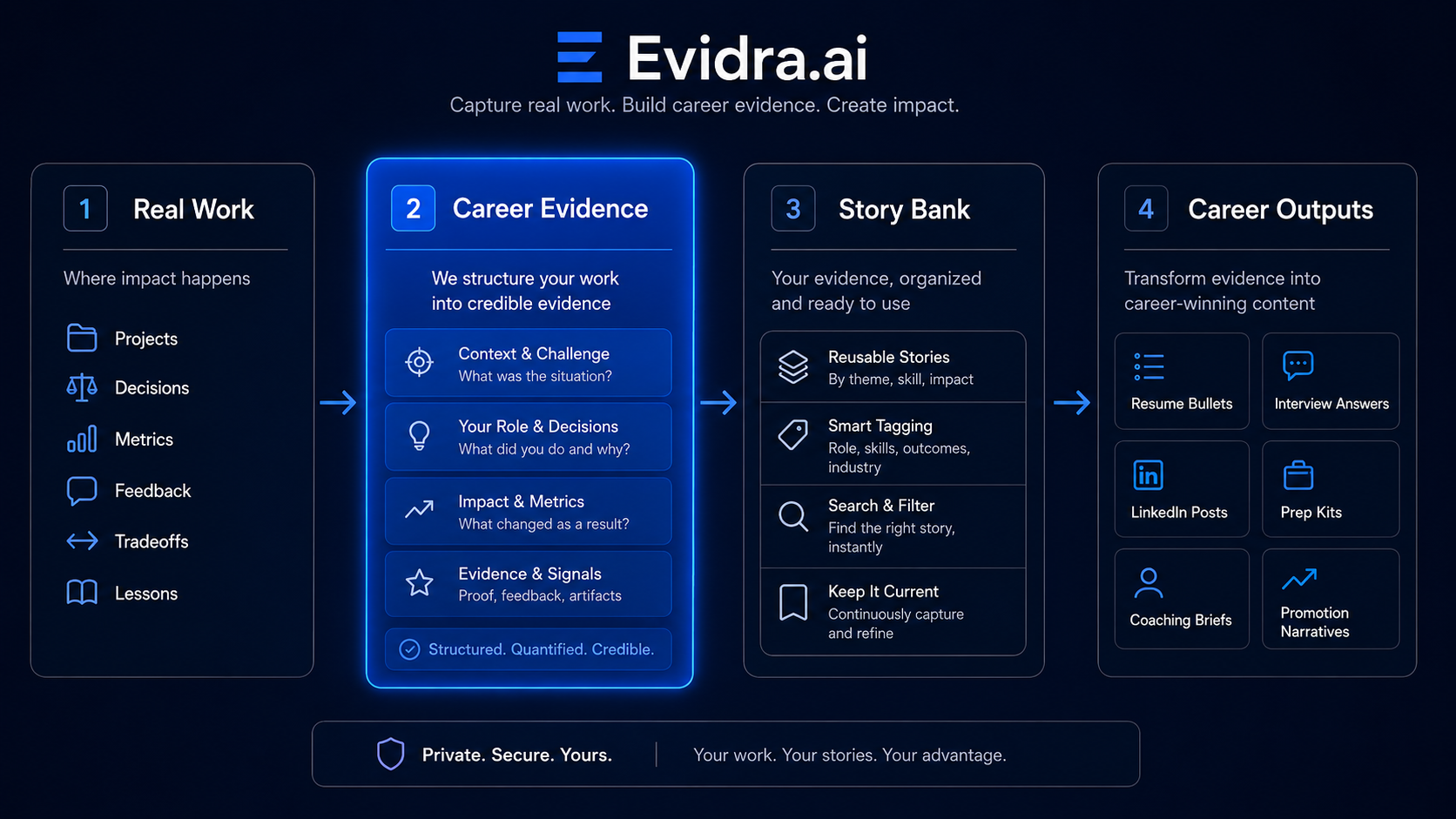
If that layer is structured, the user does not need to start from memory every time an opportunity appears.
They can start from proof.
That is why existing tools often feel useful but incomplete.
Why Resumes, LinkedIn Profiles, and AI Interview Tools Are Not Enough
Existing career tools are useful.
I do not think the problem is that resumes, LinkedIn profiles, job trackers, mock interview tools, or generic AI chatbots are bad. The problem is that they often start at the output layer.
They help after the evidence has already been compressed, forgotten, or scattered.
| Tool type | What it helps with | Missing layer |
|---|---|---|
| Resume tools | Packaging remembered achievements | Deeper proof behind each claim |
| LinkedIn profiles | Public positioning | Structured evidence behind the positioning |
| Job trackers | Managing applications | Career evidence and story quality |
| Mock interview tools | Practicing delivery | Grounded source material |
| Generic AI chatbots | Drafting answers quickly | Context, metrics, tradeoffs, and ownership |
| Live interview copilots | Real-time assistance | Trust, ethics, and authentic preparation |
Resume tools help package what the user already remembers.
LinkedIn profiles show public positioning, but not the full decision history, metric trail, feedback, tradeoffs, or lessons behind the work.
Job trackers manage applications, but they do not usually manage the evidence that makes the candidate credible.
Mock interview tools can improve practice and delivery. That matters. But delivery cannot compensate for weak source material.
Generic AI tools can generate answers, but they often begin from a blank prompt. If the prompt lacks real evidence, the answer may sound polished and still feel generic.
Live interview copilots create a different concern. I do not want Evidra.ai to be positioned around unauthorized live answer assistance. A career product should help people prepare better, think better, and explain the truth better. It should not help people fake competence in real time.
The product point of view is simple:
Evidence-first, not content-first.
If the evidence is weak, the content layer will be weak.
If the evidence is structured, every output becomes stronger.
That is why the product has to start before the job search.
The Product Insight: Career Growth Starts Before the Job Search
Most career tools start when the user is already applying.
Already interviewing.
Already rewriting a resume.
Already trying to sound polished.
But the strongest career stories are created much earlier.
They are created when the work is happening: when the user is making the decision, solving the constraint, learning from the failure, influencing the stakeholder, or seeing the metric move.
That is the moment when the evidence is fresh.
A month later, the user may remember the project name.
Three months later, they may remember the outcome.
Six months later, they may only remember the vague version: “I worked on a cross-functional project.”
Career memory compresses over time.
The details that make a story strong are usually the details that disappear first: the before-state, the constraint, the metric, the alternative option, the stakeholder objection, the tradeoff, the lesson.
That is why I do not want Evidra.ai to start at the resume layer.
I want it to start closer to the work.
The product model looks like this:
Real Work → Evidence Cards → Story Bank → Outputs
| Layer | What it means |
|---|---|
| Real Work | Projects, decisions, metrics, feedback, tradeoffs, lessons |
| Evidence Cards | Structured proof captured while the context is still clear |
| Story Bank | Reusable interview-ready stories built from real evidence |
| Outputs | Resume bullets, interview answers, LinkedIn posts, promotion narratives, coaching briefs, prep kits |
Content is the output. Evidence is the asset.
That one distinction changes the product.
If the product starts from content, it becomes another generator. It can write faster, polish better, and produce cleaner language. Useful, but limited.
If the product starts from evidence, it can compound.
The same evidence card can support a resume bullet today, an interview answer next month, a LinkedIn post later, a promotion packet during review season, and a coaching brief when the user needs outside feedback.
It also makes interview prep stronger.
A good interview answer is not just a well-structured STAR response. It needs real work, real context, real constraints, real ownership, real metrics, and real tradeoffs. Without that, the answer may sound polished but still feel generic.
This is the product layer I want Evidra.ai to own.
Not only preparation after the opportunity arrives.
Readiness before the opportunity arrives.
Related: AI Agents Are Overhyped — The Real Future Is Workflow-First Systems
What Evidra.ai Is
Evidra.ai is an evidence-first AI career growth agent.
The goal is not to start with a resume template, a generic chatbot, or a live interview shortcut. The goal is to help professionals turn real work into structured career evidence, then reuse that evidence across the moments where career progress is judged.
That includes interviews.
But it is not limited to interviews.
It includes resume bullets, story banks, role-specific prep kits, public signals, promotion narratives, and eventually coaching context.
The product thesis is that career growth becomes more useful when the system remembers the proof behind the person’s work.
At the center of Evidra.ai is the career evidence layer: projects, metrics, decisions, tradeoffs, feedback, lessons, and outcomes. Around that layer, the broader product can become a set of connected loops.
| Module | Job |
|---|---|
| CareerLoop | Helps users capture career evidence from real work |
| StoryLoop | Turns evidence into reusable career stories |
| InterviewLoop | Prepares users for specific roles, interviews, and opportunity moments |
| SignalLoop | Turns selected stories into public proof, such as LinkedIn or X posts |
| Loop Copilot | Suggests next-best career actions based on gaps, goals, and upcoming opportunities |
| CoachLoop | Adds human review later, using the user’s evidence and story bank as context |
This is the larger product direction.
But this is also where the tradeoff becomes important.
A product can have a broad vision and still need a narrow first version.
If I try to build every loop immediately, the product becomes too wide: too many workflows, too many user states, too many assumptions, and too many ways to lose focus.
That is why I am treating the full Evidra.ai system as the direction, not the first release.
The first version should prove one sharper behavior:
Can a professional take their resume, a target role, and a few career highlights, then turn them into better interview readiness using real evidence?
That is a narrower question.
It is also more testable.
It tells me whether the evidence layer creates immediate value. It tells me whether users find the prep kit useful. It tells me whether the story bank is worth saving. It tells me whether the product should expand into continuous capture, public signals, coaching, or deeper interview practice.
So Evidra.ai is the broader career evidence system.
But I am not starting by building the whole system.
The next product decision is the wedge: why the first version is Interview Sprint, not the full career OS.
Why I am Starting With Interview Sprint Instead of a Full Career OS
The full vision for Evidra.ai is broad.
That is exactly why the first version has to be narrow.
“Career growth” is a large surface area. It can mean resume improvement, interview prep, public visibility, promotion readiness, coaching, career planning, networking, or habit formation.
All of those matter.
But they do not all create the same urgency.
A user may agree that they should maintain a story bank. They may agree that they should capture evidence every week. They may even like the idea of a long-term career growth system.
But agreement is not the same as action.
The sharper moment is different:
“I have an interview.”
“I am applying for this role.”
“I need to explain my experience better.”
“I have a promotion conversation coming up.”
“I do not know which stories to use.”
That is why I am starting with Interview Sprint.
Interview Sprint is the first MBP wedge: a focused workflow that turns a resume, target job description, and career highlights into evidence cards, 5-7 interview-ready stories, a role-specific prep kit, practice feedback, and a 7-day improvement plan.
At a high level, the flow is:
Resume + JD + career highlights → evidence cards → 5-7 stories → prep kit → practice feedback → 7-day plan
This is not the whole career OS.
It is the narrowest version that can test the core belief: real career evidence can create better interview readiness than generic prep.
| MBP decision filter | Why Interview Sprint fits |
|---|---|
| Urgency | A specific role or interview creates a clear preparation deadline |
| Concrete output | The user gets stories, a prep kit, feedback, and an improvement plan |
| Immediate value | The output maps directly to an upcoming opportunity |
| Future retention | The generated stories can become the start of a reusable story bank |
| Long-term foundation | The workflow seeds the career evidence graph instead of being a one-off document |
This wedge is also useful because it forces scope discipline.
If I start with the full career OS, I have to solve too many problems at once: continuous capture, public signaling, coaching, reminders, integrations, content workflows, and habit formation.
That is too much surface area for the first test.
With Interview Sprint, the first product question becomes much sharper:
Can Evidra.ai help someone prepare for a specific opportunity using real evidence from their career?
That question is measurable.
Did the user upload a resume and target JD?
Did they add career highlights?
Did the system generate useful evidence cards?
Did the user save interview-ready stories?
Did the prep kit feel more useful than generic AI prep?
Did the user know what to improve over the next seven days?
Those are better early signals than “Do users like the idea of a career growth platform?”
There is also a strategic reason this matters.
If Interview Sprint works, it does not end as a one-time prep report. It creates the first durable asset: the story bank. The stories can be improved, reused, matched to future roles, turned into public signals, or used as coaching context later.
So the wedge is narrow, but it is not disposable.
It is the first path into the larger system.
Related: The AI Red Ocean Trap — When “AI-Powered” Stops Being a Strategy
The First Workflow: Resume + JD + Evidence → Stories → Prep Kit
The first workflow has to make the product concrete.
Not conceptually useful.
Actually useful.
For Interview Sprint, the workflow starts with a specific opportunity: a target role, interview, promotion conversation, or career transition. The user is not coming in to “manage their career” in the abstract. They are trying to prepare for something real.
So the workflow needs to move from scattered inputs to a usable prep asset.
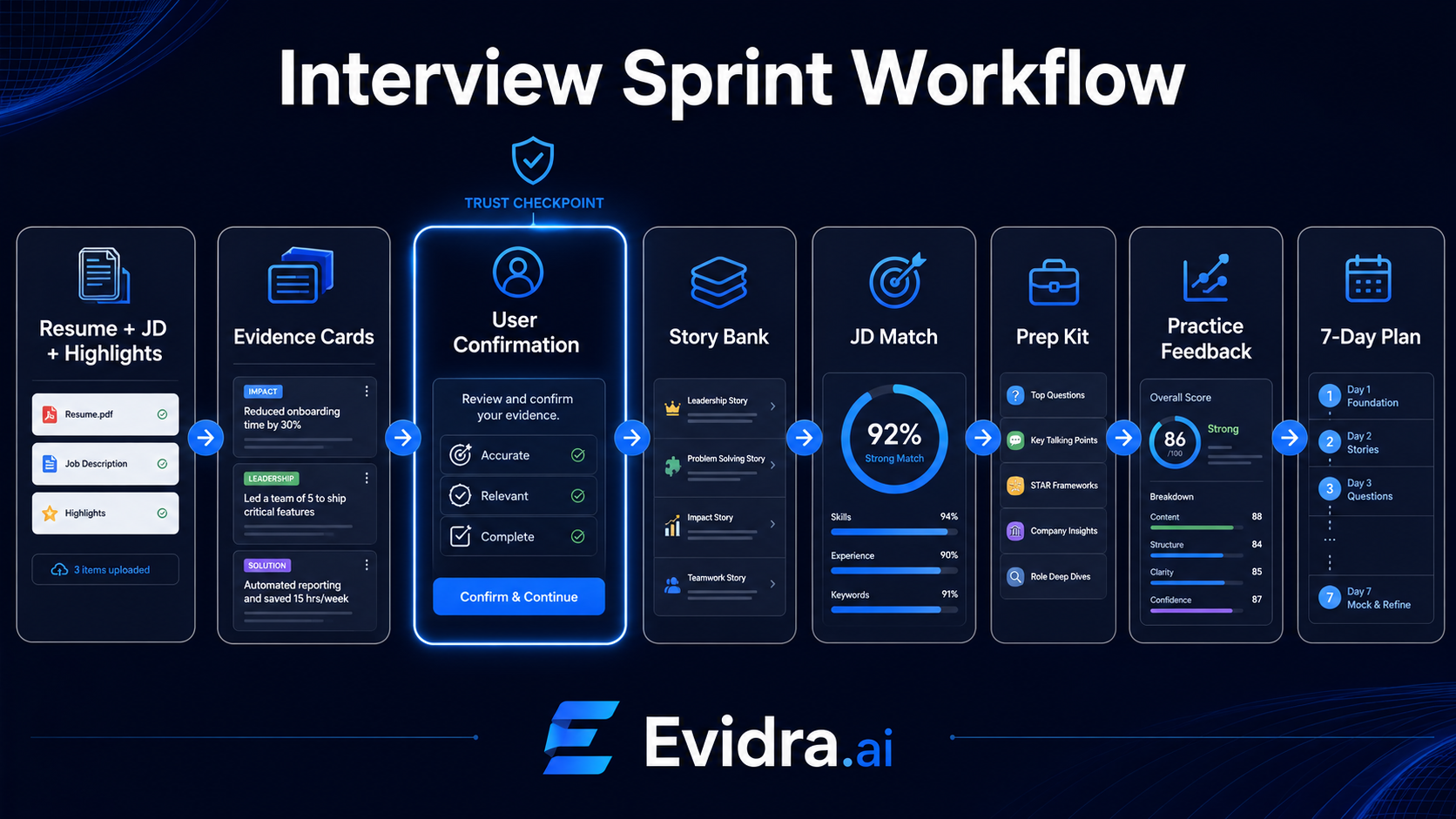
The first version looks like this:
| Step | User action | Product output |
|---|---|---|
| 1 | Create career profile | Basic context: current role, target role, seniority, goals, biggest concern |
| 2 | Upload resume and paste target JD | Parsed resume, role expectations, required skills, likely interview focus |
| 3 | Add 3-5 career highlights | Extra context that the resume usually misses |
| 4 | Generate evidence cards | Structured proof objects with missing-metric questions |
| 5 | Confirm or improve evidence | User-approved source material |
| 6 | Generate 5-7 stories | Interview-ready STAR/CAR stories |
| 7 | Match stories to the JD | Story-to-competency map and visible gaps |
| 8 | Generate prep kit | Role-fit diagnosis, likely questions, answer bank, risks, improvement plan |
| 9 | Practice top questions | Text-based answer practice |
| 10 | Receive feedback and 7-day plan | Specific drills, rewrites, and next actions |
The most important step is not the AI generation.
It is evidence confirmation.
If the system extracts a metric, the user should be able to verify it. If the metric is missing, the system should ask for it. If the role context is unclear, it should surface the gap. If a story sounds impressive but is not supported by the evidence, it should not ship as a confident claim.
That matters because career products deal with trust.
A prep kit is only useful if the user can defend it in a real conversation. A story is only useful if it is grounded in what actually happened. A rewritten answer is only useful if it makes the truth clearer, not bigger than it was.
This is why the workflow should not be a single prompt that says, “Here is my resume and JD, write interview answers.”
That is too loose.
The better workflow is structured:
Resume + JD + Highlights → Evidence Review → Story Bank → JD Match → Prep Kit → Practice → Improvement Plan
Each stage has a job.
The resume gives baseline history.
The JD defines the target.
The highlights add missing context.
The evidence cards create source material.
The story bank turns proof into reusable narratives.
The JD match makes the prep role-specific.
The prep kit gives the user a focused artifact.
The practice loop turns the artifact into behavior change.
The 7-day plan turns feedback into action.
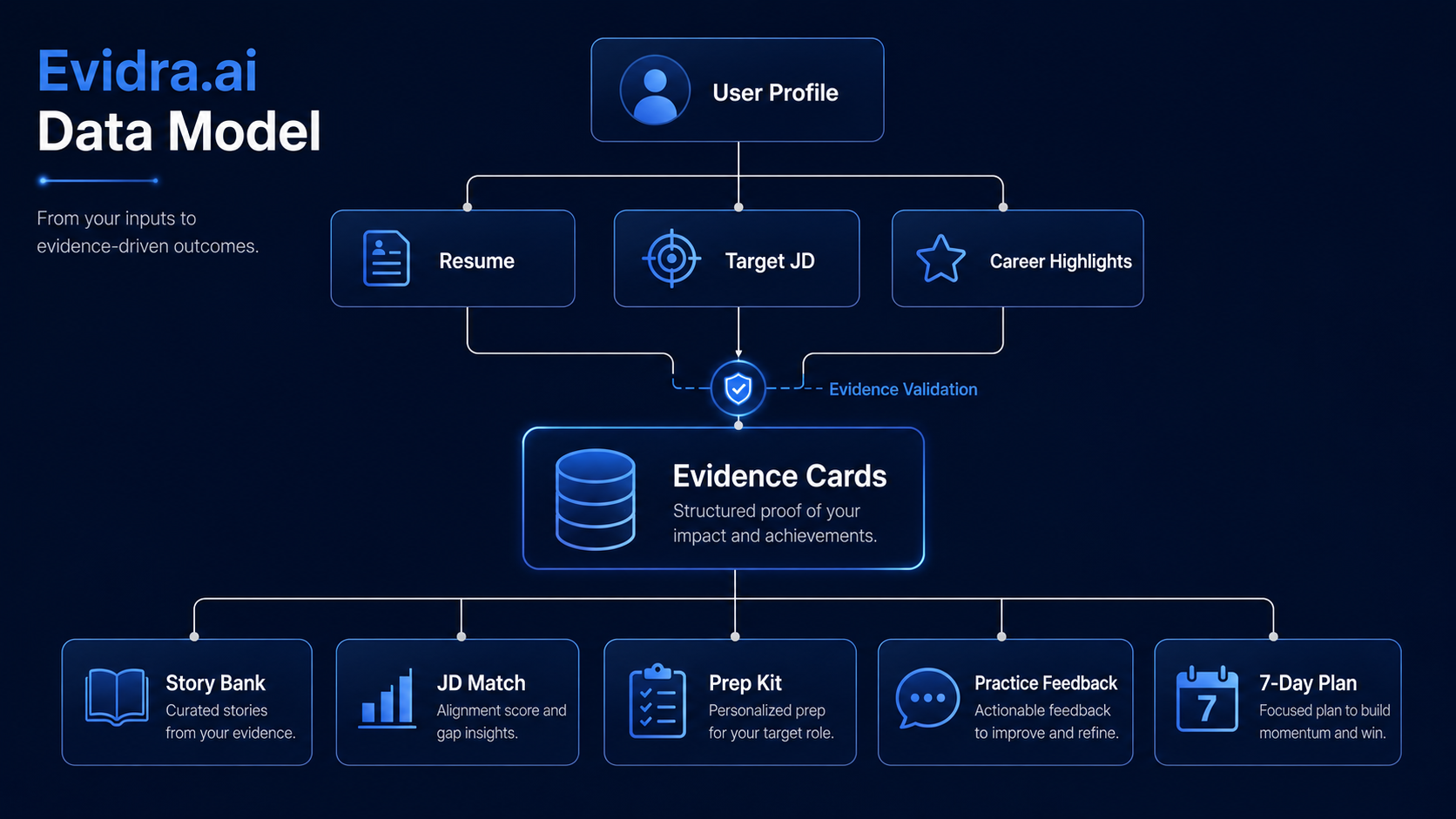
This workflow also keeps the first version honest.
It does not require deep integrations.
It does not require a mobile app.
It does not require a full coach marketplace.
It does not require live interview assistance.
It requires the product to do one thing well: turn real career evidence into role-specific interview readiness.
That is the first buildable version of the wedge.
What I am Deliberately Not Building Yet
Focus is a product decision.
It is not just about moving faster. It is about making the first version easier to understand, easier to trust, and easier to validate.
The broader Evidra.ai vision can expand in many directions: continuous evidence capture, public signals, coaching, integrations, reminders, mobile habits, and role-specific career intelligence.
But v1 should not carry all of that weight.
For the first version, I want to keep the product centered on one job: help a professional turn real career evidence into role-specific interview readiness.
That means cutting attractive features on purpose.
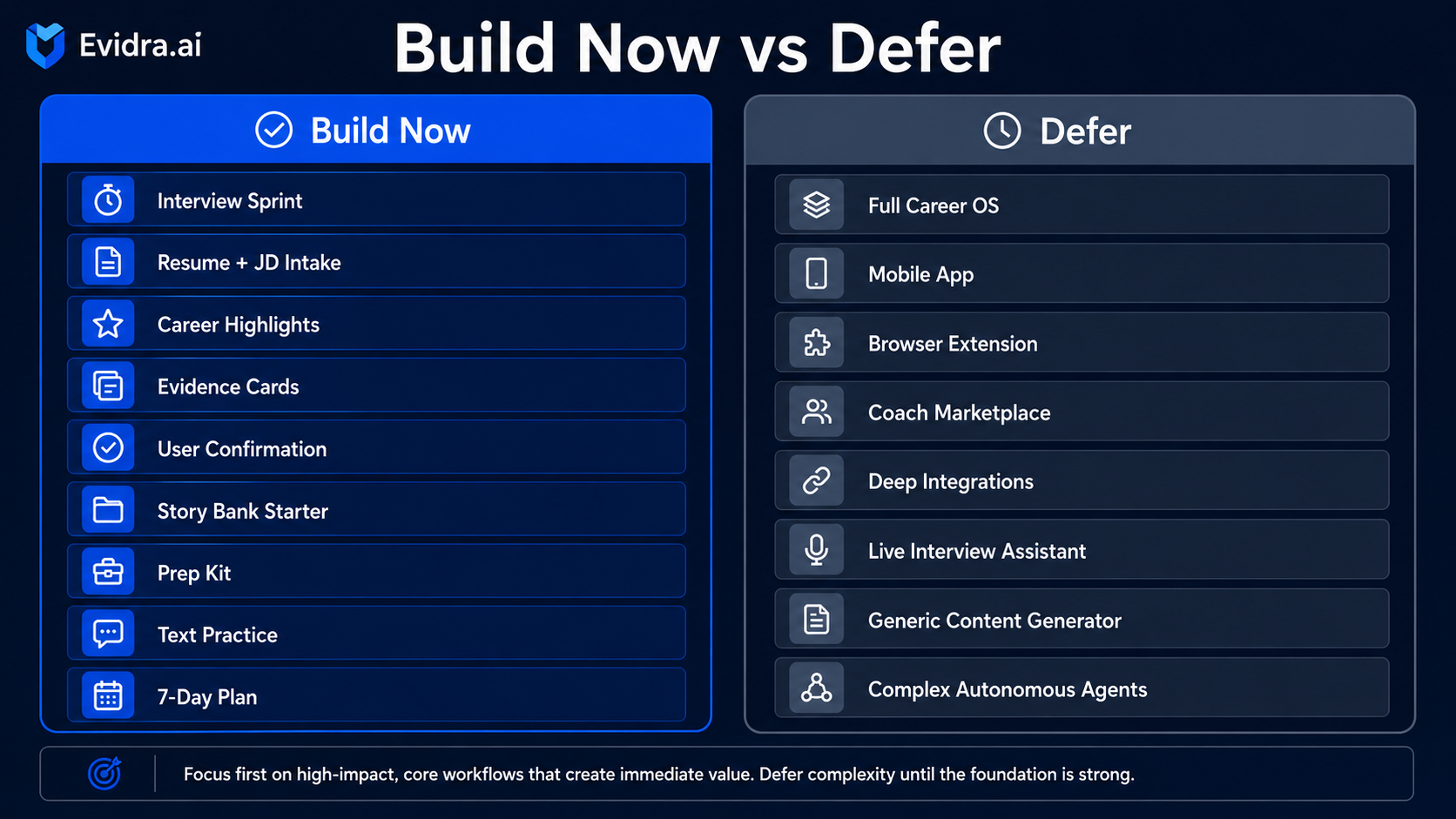
| Build now | Defer |
|---|---|
| Resume and JD intake | Full career operating system |
| Career highlights | Mobile app |
| Evidence cards | Browser extension |
| User evidence confirmation | Full coach marketplace |
| Story bank starter | Slack, Gmail, Jira, Notion, calendar integrations |
| Role-specific prep kit | Unauthorized live interview answer assistant |
| Text-based practice feedback | Generic LinkedIn content generation detached from evidence |
| 7-day improvement plan | Complex autonomous agent workflows |
I am not building the full career operating system first because the surface area is too broad. Career growth includes many jobs: prep, visibility, coaching, planning, promotion, habit formation, and networking. Trying to solve all of them at once would blur the first product test.
I am not building a mobile app first because the first risk is not mobile convenience. The first risk is whether the core evidence-to-prep workflow is valuable enough.
I am not building a browser extension first because capture automation only matters after the prep workflow proves demand. A browser plugin can be useful later for job descriptions, LinkedIn, and opportunity triggers, but it should not be the first dependency.
I am not building a full coach marketplace first because marketplaces add operational complexity before the core product is proven. Human review can come later as a premium layer, but the first question is whether the evidence system itself creates useful prep.
I am not building complex integrations with Slack, Gmail, Jira, Notion, calendar, or similar tools first. Those integrations can reduce capture friction later, but they also introduce permissions, privacy, parsing, stitching, and trust challenges. Manual input is less elegant, but it is a cleaner way to validate the core workflow.
I am not building unauthorized live interview answer assistance. That is a hard line. Evidra.ai should help people prepare better, think better, and explain the truth better. It should not help people fake competence in real time.
I am also not building generic LinkedIn content generation detached from evidence. Public signals matter, but if the content is not grounded in real work, it becomes another AI content layer. That is not the product thesis.
The pattern is simple:
Do not automate before the workflow is understood.
Do not integrate before the manual path works.
Do not expand before the wedge is validated.
Do not generate content before the evidence is grounded.
These cuts make the product smaller.
But they also make it sharper.
Why I am Building This in Public
Building in public is not just marketing.
For this project, it is part of the product process.
Evidra.ai is still being shaped through problem framing, scope cuts, workflow decisions, AI guardrails, and MBP validation. If I only share the finished version later, the most useful part of the work disappears: the reasoning behind the product.
That reasoning matters to three groups.
For product builders, the useful part is not “I am building an AI product.” That is too broad. The useful part is how the wedge is chosen, what gets cut, where AI should be used, where it should not be used, and how a large product vision becomes one testable workflow.
For potential early customers, the useful part is different. They can react to the pain before the product is overbuilt. If the career evidence problem feels real, that is signal. If the Interview Sprint workflow feels useful, that is signal. If the language does not match how they experience the problem, that is also signal.
For recruiters and hiring managers, this build is a way to show the work behind the work: problem framing, prioritization, product judgment, AI workflow design, and communication. A finished case study can show the output. A build log can show the decision process.
That is why I want this series to be more than progress updates.
The future posts should document the actual product thinking:
| Build-in-public topic | Why it matters |
|---|---|
| Personas | Shows who the product is for first and who is deliberately later |
| Workflows | Shows how the user moves from evidence to readiness |
| Prompts | Shows where AI helps and where it needs guardrails |
| Architecture | Shows how the first version can stay simple without becoming fragile |
| GTM | Shows how the problem is tested with real audiences |
| Monetization decisions | Shows how the wedge connects to willingness to pay, with details saved for a later dedicated post |
This is also a forcing function for me.
Writing publicly makes vague product thinking harder to hide. If I cannot explain the problem clearly, the product is probably not clear enough. If I cannot explain the wedge, the scope is probably too broad. If I cannot explain what I am not building, the roadmap is probably too loose.
That is the value of the build-in-public format.
It turns the product into a sequence of decisions that can be inspected, challenged, and improved.
Key Takeaways
Here is the simplest version of the argument.
-
Evidra.ai is an evidence-first AI career growth agent.
It is being built to help professionals turn real work into structured career evidence, stories, prep kits, public signals, and opportunity readiness. -
The core problem is career evidence decay.
Professionals do meaningful work, but the proof behind that work often disappears before an interview, recruiter call, promotion conversation, or visibility opportunity arrives. -
Career evidence is the structured proof behind a professional claim.
It includes the project, problem, action, decision, tradeoff, metric, stakeholder feedback, lesson, and outcome behind an achievement. -
Most existing tools start too late.
Resume tools, LinkedIn profiles, job trackers, mock interview tools, and generic AI chatbots can be useful, but they usually operate after the evidence has already been compressed, forgotten, or scattered. -
The product insight is evidence-first, not content-first.
If the evidence is structured first, the outputs become stronger: resume bullets, interview stories, LinkedIn posts, promotion narratives, coaching briefs, and prep kits. -
Interview Sprint is the first MBP wedge.
It is a focused workflow that turns a resume, target JD, and career highlights into evidence cards, 5-7 interview-ready stories, a role-specific prep kit, practice feedback, and a 7-day improvement plan. -
Interview Sprint is first because it is urgent and concrete.
“Career growth” is broad. “Help me prepare for this specific role or interview” is sharper, easier to understand, and easier to validate. -
The first version deliberately excludes broad platform features.
I am not starting with a full career OS, mobile app, browser extension, full coach marketplace, complex integrations, unauthorized live interview assistance, or generic content generation detached from evidence. -
Building in public is part of the product process.
The goal is to show the product decisions behind Evidra.ai: the problem framing, wedge, scope cuts, AI workflow choices, architecture, GTM thinking, and future monetization decisions.
FAQ
What is Evidra.ai?
Evidra.ai is an evidence-first AI career growth agent. It helps professionals convert real work into structured career evidence, reusable stories, role-specific prep kits, public signals, and opportunity readiness.
What problem does Evidra.ai solve?
Evidra.ai is being built around career evidence decay. Professionals often do meaningful work, but the proof behind that work gets scattered or forgotten before interviews, promotions, recruiter conversations, or public visibility moments.
What is career evidence?
Career evidence is structured proof of real professional work. It includes projects, metrics, decisions, tradeoffs, stakeholder feedback, lessons, outcomes, skills, and ownership signals.
How is Evidra.ai different from generic AI interview prep?
Generic AI interview prep often starts from a prompt and generates answers. Evidra.ai starts from real career evidence first, then turns that evidence into interview stories, role-specific prep, and improvement plans.
What is Interview Sprint?
Interview Sprint is the first focused Evidra.ai workflow. It turns a resume, target job description, and career highlights into evidence cards, 5-7 interview-ready stories, a prep kit, practice feedback, and a 7-day improvement plan.
Why not build the full career platform first?
The broader product vision is large. The first version needs to validate one urgent, concrete workflow before expanding into mobile, browser extensions, deep integrations, coach marketplaces, or continuous career capture.
What Comes Next
Week 1 is about the problem and the wedge.
The problem is career evidence decay.
The wedge is Interview Sprint.
The product decision is to start narrow before expanding into the broader Evidra.ai vision.
Next, I’ll break down the user personas.
That means looking at who this should serve first, who should come later, and how those choices shape the product roadmap. The first persona work will focus on active jobseekers, career switchers, and AI/product professionals because those are the moments where the evidence-to-interview-readiness pain is clearest to test.
If you are interested in AI product building, career products, interview readiness, or evidence-first workflows, follow or connect with me on LinkedIn.
If the career evidence problem resonates, DM me.
And when the YouTube video is live, I’ll link the full product-builder breakdown there too.
This is the start of the Evidra.ai build-in-public journey: one problem, one wedge, one product decision at a time.
AI Workflow Audit
Want to apply this to your workflow?
I help B2B teams design human-approved AI workflow systems for CRM hygiene, lead research, content ops, and internal automation.
Book Free Review