The AI Red Ocean Trap: When “AI-Powered” Stops Being a Strategy
When everyone builds an AI product, nobody has one.
Introduction
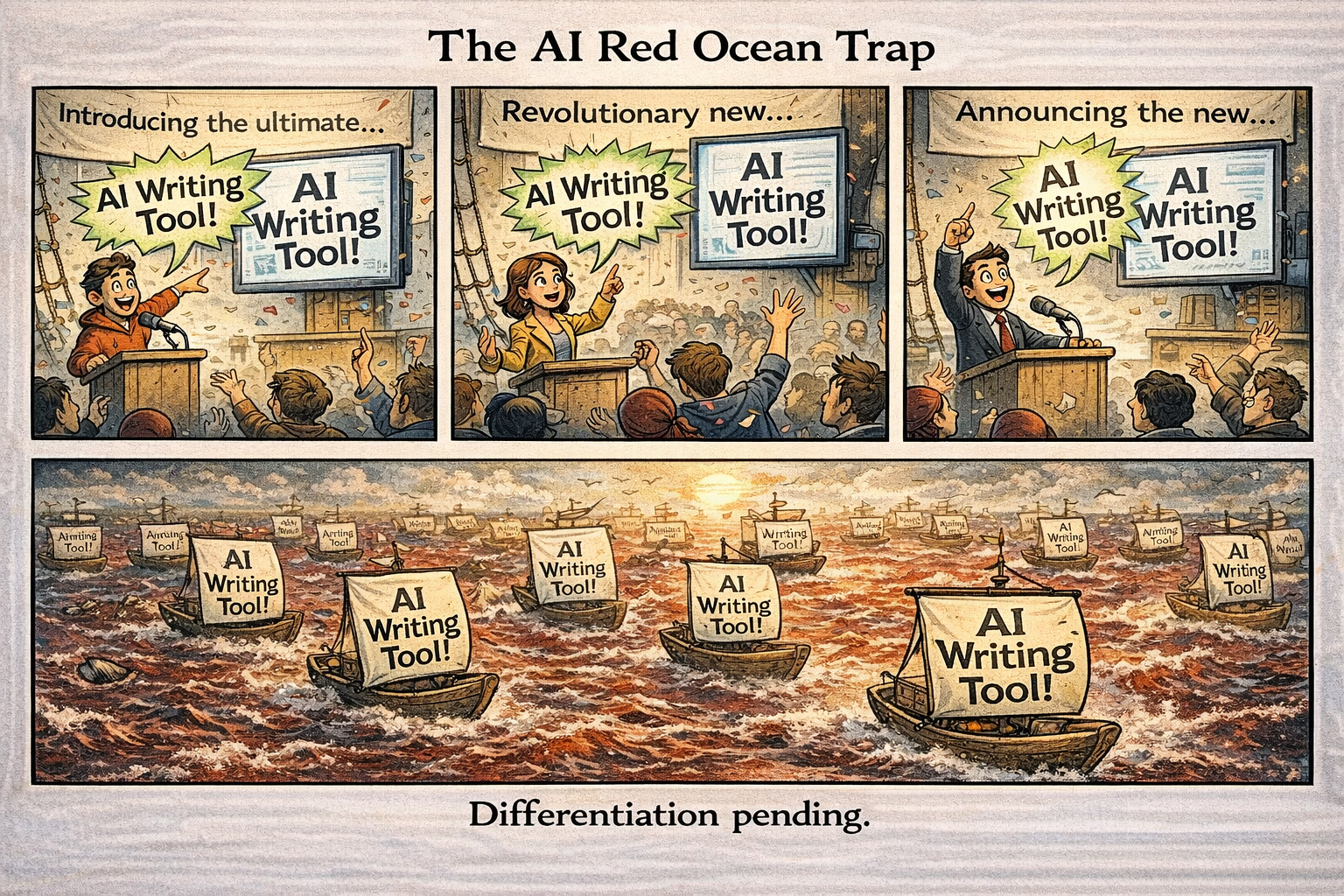
Open LinkedIn or Product Hunt on any given day and a familiar pattern appears.
“Introducing our AI writing assistant.”
“Meet our AI-powered productivity tool.”
“Announcing the next-generation AI content platform.”
Different founders. Different logos. Same announcement.
At first glance, this looks like an innovation boom. But look closer and a different story emerges: a crowded sea of products that look, behave, and even respond almost identically.
Welcome to the AI Red Ocean Trap.
In business strategy, a red ocean describes a market where competitors fight for the same customers with nearly indistinguishable offerings. Profit margins shrink. Differentiation fades. Marketing becomes louder while value remains unchanged.
The recent explosion of AI tools risks turning entire product categories into exactly that.
Ironically, the most transformative technology in decades is producing a surprising outcome: a wave of highly similar products competing on the same features.
And the reason is simple.
Many companies are treating “AI-powered” as a strategy.
It isn’t.
The Rise of the AI Red Ocean
To understand why this trap exists, we need to look at how modern AI products are built.
Unlike previous technological waves, most AI startups today rely on the same underlying foundation models. These models—large language models and generative AI systems—are incredibly powerful, but they are also widely accessible.
This democratization is a remarkable achievement.
But it has an interesting side effect.
When dozens or hundreds of teams build products on top of the same intelligence layer, capabilities begin to converge.
The result?
- Similar outputs
- Similar features
- Similar user experiences
The differentiation that companies assume will emerge from AI simply doesn’t.
The entire category begins to resemble a fleet of identical ships sailing the same ocean.
When AI Becomes a Feature Instead of a Strategy
Many product teams fall into a predictable pattern when building AI products.
The roadmap often looks something like this:
Week 1: Add AI writing
Week 2: Add AI summarization
Week 3: Add AI chat interface
Week 4: Add AI agents
Soon every competitor ships the same checklist.
From the outside, these features appear innovative. Internally, they are often variations of the same prompt wrapped in slightly different interfaces.
This creates a dangerous illusion: feature velocity masquerading as product strategy.
The problem is that features are easy to copy. In the AI era, they are copied faster than ever.
If differentiation relies purely on AI functionality, competitors can close the gap within weeks.
The outcome is a category full of tools that are technically impressive yet strategically indistinguishable.
The Illusion of Differentiation
Why does this happen so often?
Three structural forces drive the AI red ocean phenomenon.
1. Foundation Model Commoditization
Foundation models are becoming infrastructure.
Just as cloud computing standardized backend infrastructure, large AI models are standardizing intelligence layers.
This is good for developers. It accelerates innovation.
But it also means that raw AI capability is rarely a moat.
If every product can access the same model, intelligence alone does not create differentiation.
2. Feature Parity Arms Race
Once one product launches a successful AI feature, competitors quickly follow.
A common cycle emerges:
- Product A launches AI capability
- Product B copies the feature
- Product C launches a similar version
- The feature becomes table stakes
What initially looked like innovation quickly becomes baseline expectation.
The competitive advantage disappears.
3. AI as a Marketing Label
Many companies position themselves as:
“AI-powered X.”
But this framing focuses on technology rather than outcomes.
Users rarely care that something is AI-powered.
They care about whether their work gets easier, faster, or better.
The moment AI becomes the headline instead of the outcome, strategy begins to drift.
Where Real AI Product Strategy Lives
If AI capabilities alone are not a moat, where does real differentiation come from?
Successful AI products tend to build advantages in three deeper layers.
1. Unique Data
The most durable AI moat is proprietary data.
Generic models trained on the internet produce generic outputs.
But when AI systems are combined with unique datasets—domain expertise, behavioral data, workflow insights—the product becomes difficult to replicate.
Think of this as context advantage.
AI that understands your specific domain always beats AI that understands everything vaguely.
2. Workflow Integration
The most successful AI products are not standalone tools.
They are embedded inside existing workflows.
Instead of asking users to open a separate AI product, these systems operate where work already happens.
Examples include:
- coding assistants inside development environments
- AI copilots embedded in productivity software
- AI features integrated into creative tools
When AI becomes part of the workflow rather than a separate destination, it stops being a novelty and becomes infrastructure.
3. Outcome Ownership
Many AI tools focus on generating content.
But the real opportunity lies in owning outcomes, not outputs.
For example:
A weak product promise might be:
“Generate a marketing blog.”
A stronger promise is:
“Publish an optimized article that ranks on search engines.”
The difference is subtle but powerful.
One generates text.
The other solves a business problem.
AI products that own outcomes create significantly more value.
A Simple Mental Model for AI Product Strategy
A useful way to think about AI differentiation is through three layers:
AI Capability → Workflow Integration → Outcome Ownership
Most products compete in the first layer.
That is the easiest layer to copy.
The deeper strategic advantage lies in layers two and three.
In other words:
Anyone can build AI features.
Far fewer companies can build AI-powered outcomes embedded inside real workflows.
That is where defensibility begins.
Key Takeaways
The AI red ocean trap emerges when teams confuse technology adoption with strategic differentiation.
Key insights:
- AI capability alone is rarely a moat.
- Feature-based competition leads to rapid parity.
- Unique data creates stronger AI advantages.
- Embedding AI into workflows increases defensibility.
- Owning outcomes is more valuable than generating outputs.
Most importantly:
The key question for AI product teams is not:
“Where can we add AI?”
It is:
“What outcome can only our AI deliver?”
Conclusion
Right now, the ocean is full of boats labeled:
“AI Writing Tool.”
Each one promises intelligence.
Each one claims innovation.
Most are sailing in the same direction.
The companies that win will not build better boats.
They will sail to a different ocean.
AI is not the product.
AI is the engine.
Product strategy is still about:
- problems
- users
- outcomes
- moats.
Sources
- https://www.productcompass.pm/p/how-to-create-an-ai-product-strategy
- https://www.news.aakashg.com/p/ai-product-strategy
Additional references:
- Hamilton Helmer — Seven Powers
- Chan Kim & Renée Mauborgne — Blue Ocean Strategy
- Andreessen Horowitz — AI market analyses
- Stanford HAI research on foundation models
AI Workflow Audit
Want to apply this to your workflow?
I help B2B teams design human-approved AI workflow systems for CRM hygiene, lead research, content ops, and internal automation.
Book Free Review