Enterprise finance & commercial operations workflow
From messy quote requests to approved commercial output
iQuote is a working AI-assisted quote workflow that extracts unstructured customer requests, resolves products and inventory, applies deterministic pricing rules, and routes exceptions through human approval before producing a customer-ready quote.
Functional portfolio demo using representative commercial data
The business problem
Quote creation is not only a document-generation problem
Commercial requests arrive through emails, notes and loosely structured documents. Producing a valid quote requires product matching, inventory decisions, pricing policy, exception handling and delegated approval. AI can interpret the request, but it should not independently control commercial truth.
Weak pattern
Prompt → model → customer quote
The model is implicitly trusted to interpret the request and establish commercial output.
iQuote pattern
Request → extraction → validation → deterministic rules → exception handling → approval → customer-safe output
AI handles ambiguity while application state, business rules and people control commitments.
End-to-end workflow
A governed path from intake to customer output
Exceptions return to review rather than being hidden or guessed. Workflow events preserve an auditable history of what the system proposed, what the user confirmed and what an approver decided.
Three proof points
The demo is designed around control, not a chatbot
Structured extraction
Converts a free-text commercial request into editable, typed quote information with source-backed values, confidence and missing-field handling.
Deterministic commercial truth
Keeps catalogue, inventory, pricing, margin, totals and customer terms outside the language model.
Human-controlled exceptions
Packages discount and fulfilment exceptions with decision context before any customer-facing output is produced.
Product walkthrough
Follow the quote from request intake to customer-safe output
Each stage exposes what the system extracted, what deterministic services resolved and where a person must review or approve the commercial decision.
Begin with the customer’s operational request
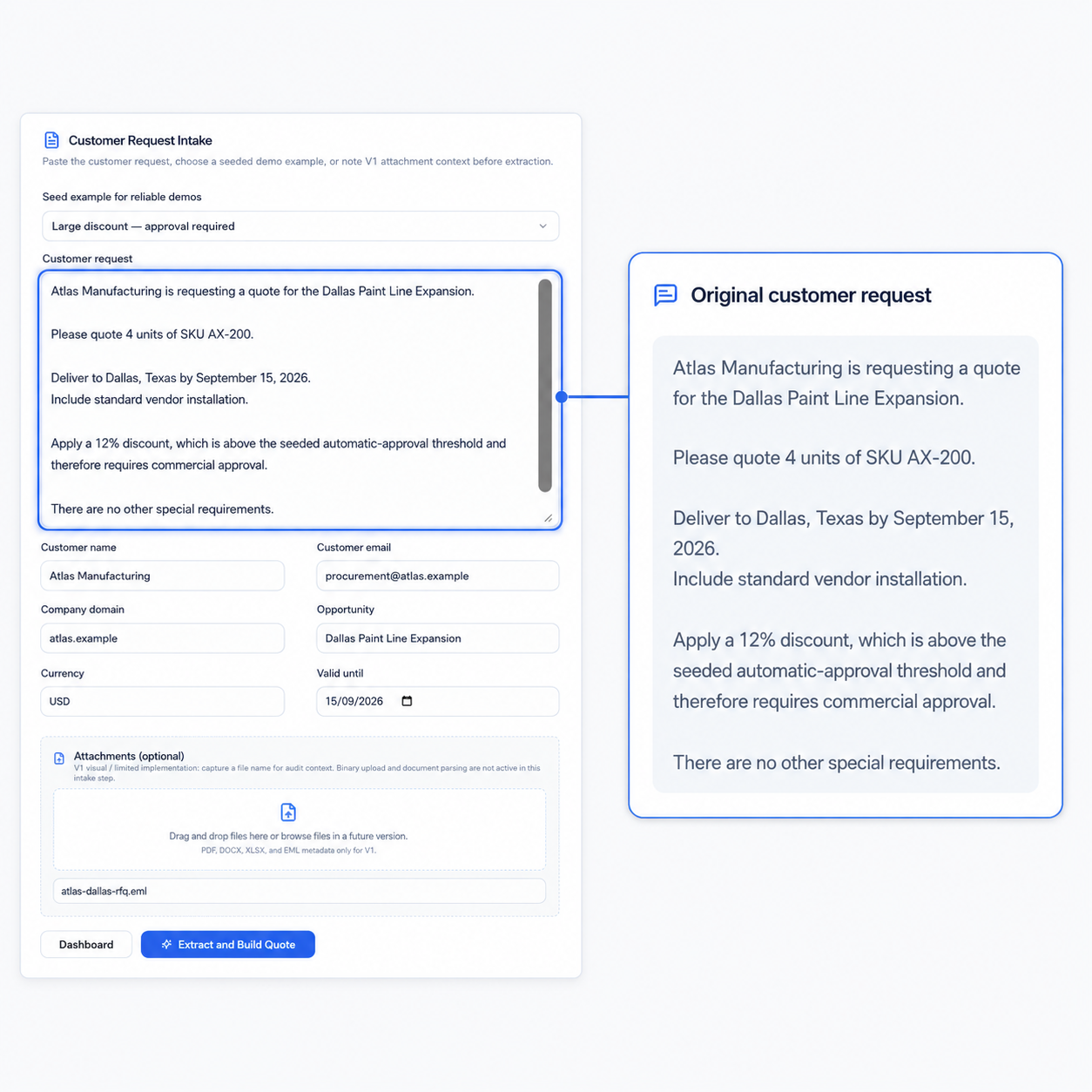
The workflow starts with an unstructured quote request, customer context, opportunity details and commercial requirements rather than an empty chat interface.
The original request remains visible so every downstream field can be reviewed against its source.
Convert the request into reviewable structured fields
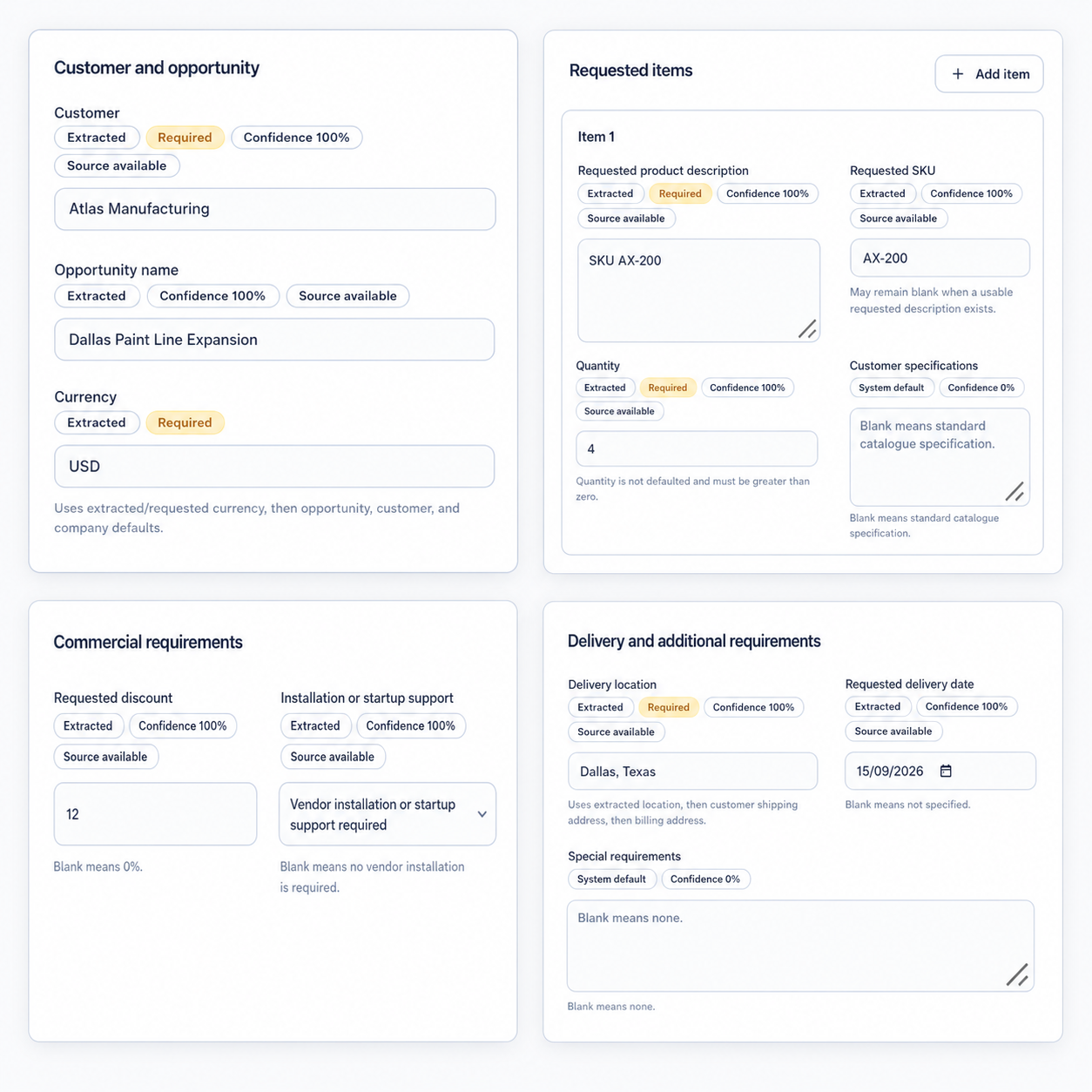
AI-assisted extraction proposes customer, product, quantity, discount, installation and delivery fields with confidence and source indicators.
The sales representative can review and correct the draft before any catalogue, inventory or pricing decision is made.
Resolve fulfilment and pricing from deterministic business data
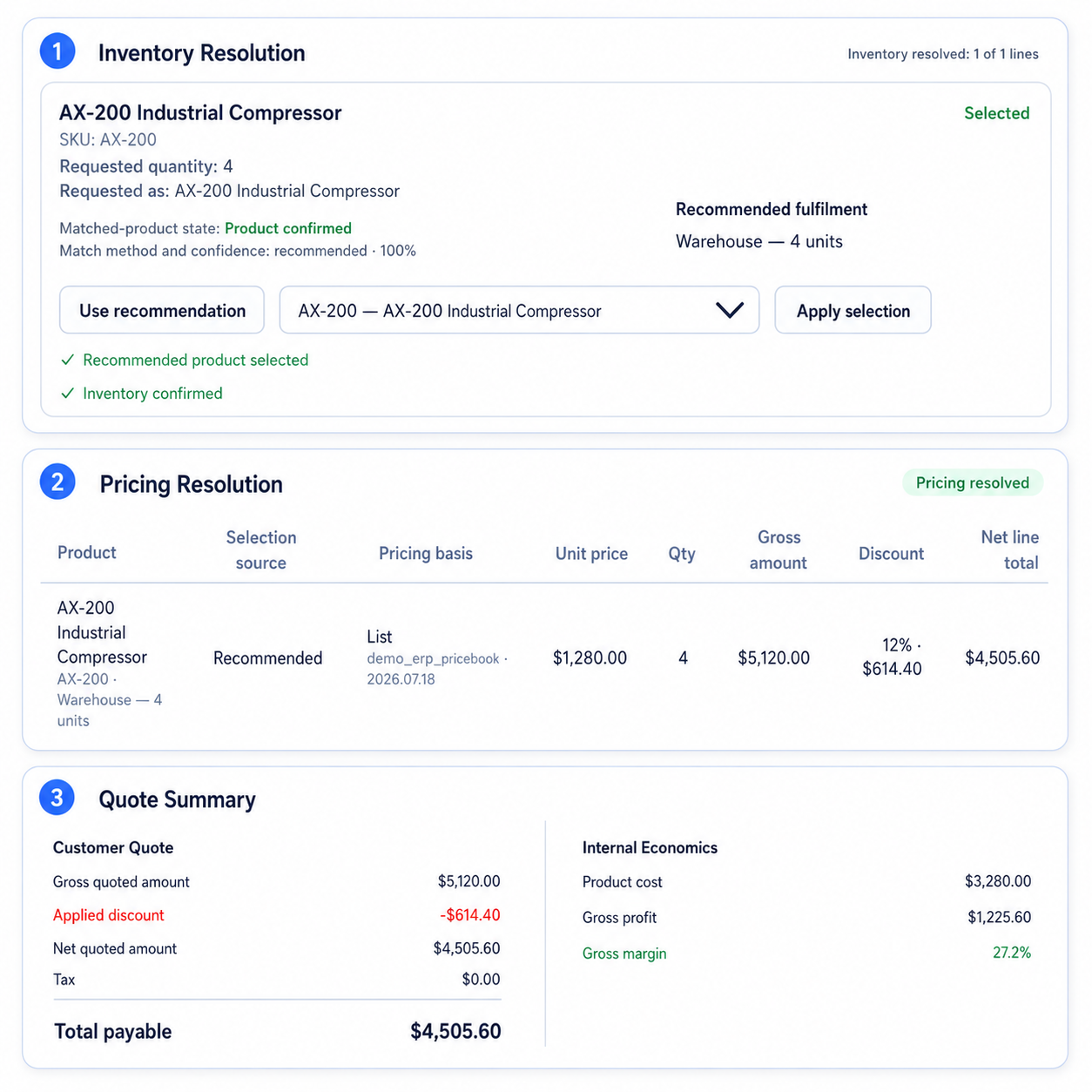
Confirmed product matches are resolved against available warehouse inventory before the pricing service applies the active price source, requested discount and commercial calculations.
The workspace keeps inventory selection, pricing basis, quoted totals and internal economics visible so the representative can verify the commercial result before continuing.
Block unsupported fulfilment instead of guessing
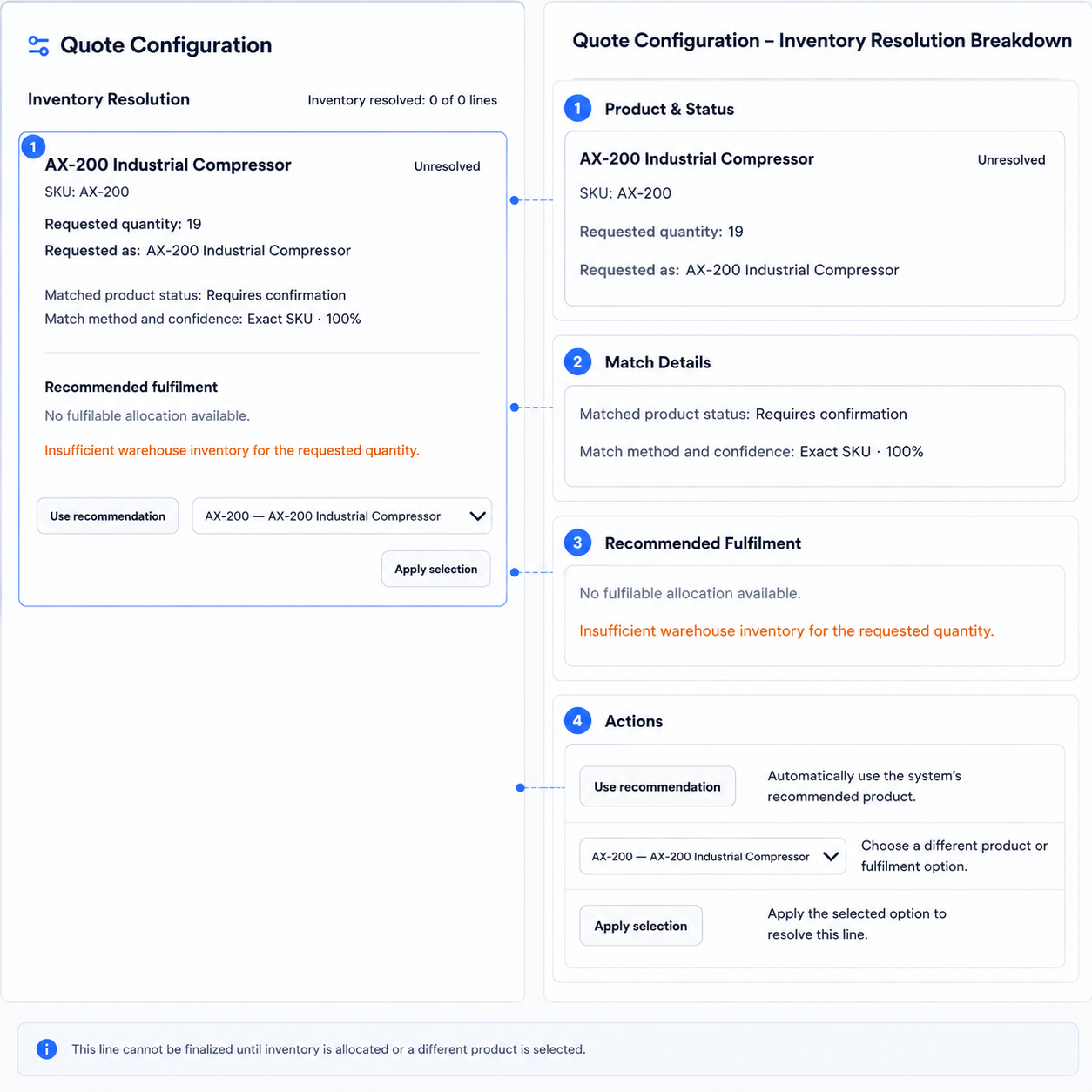
When the requested quantity cannot be fulfilled from seeded warehouse inventory, the quote remains unresolved and the user must choose a supported path.
The application makes operational uncertainty explicit rather than inventing stock availability or silently producing an incomplete commitment.
Route policy exceptions with commercial context
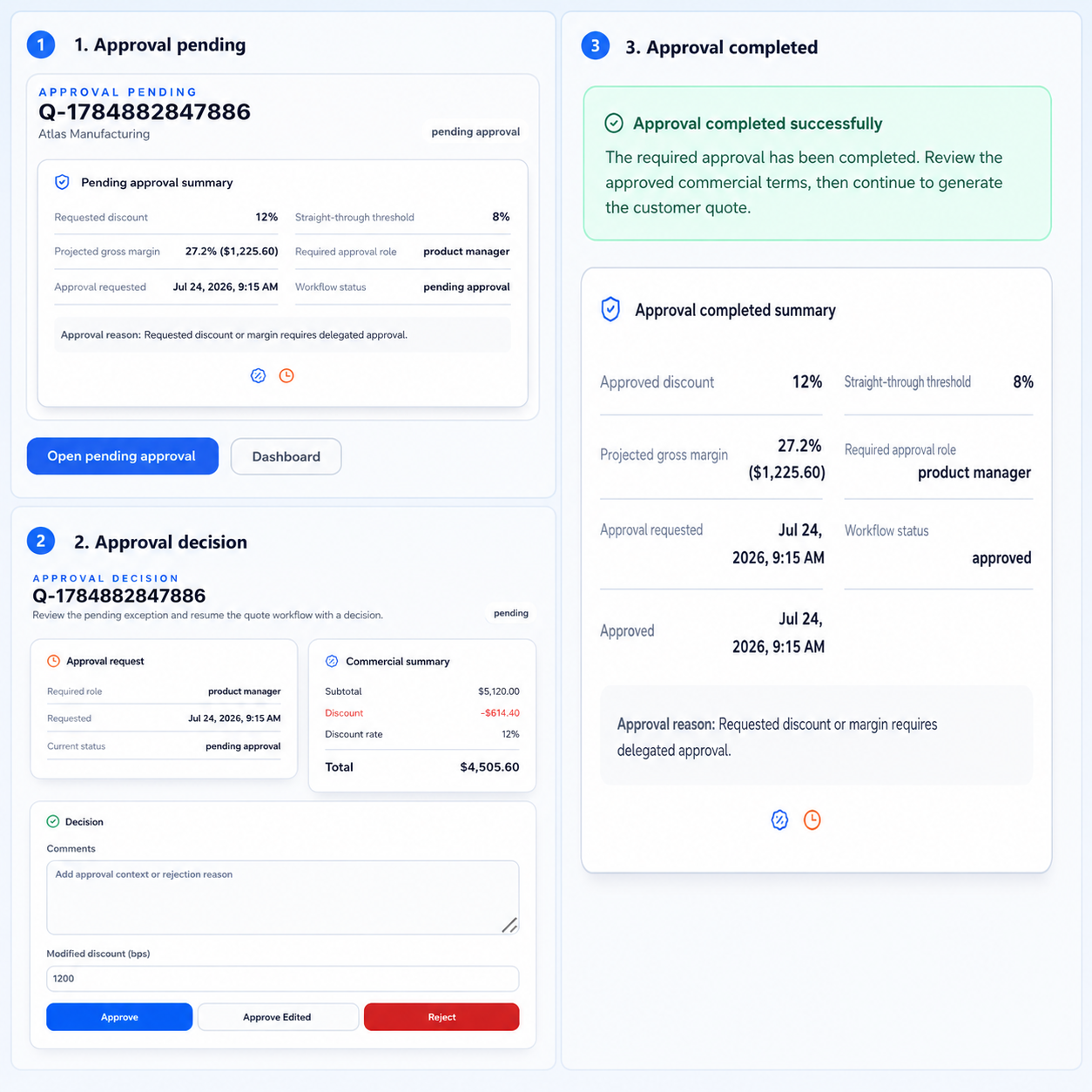
A requested discount above the straight-through threshold creates a delegated approval containing the subtotal, discount, margin and required approval role.
The approver can accept, modify or reject the exception before the workflow returns to quote generation.
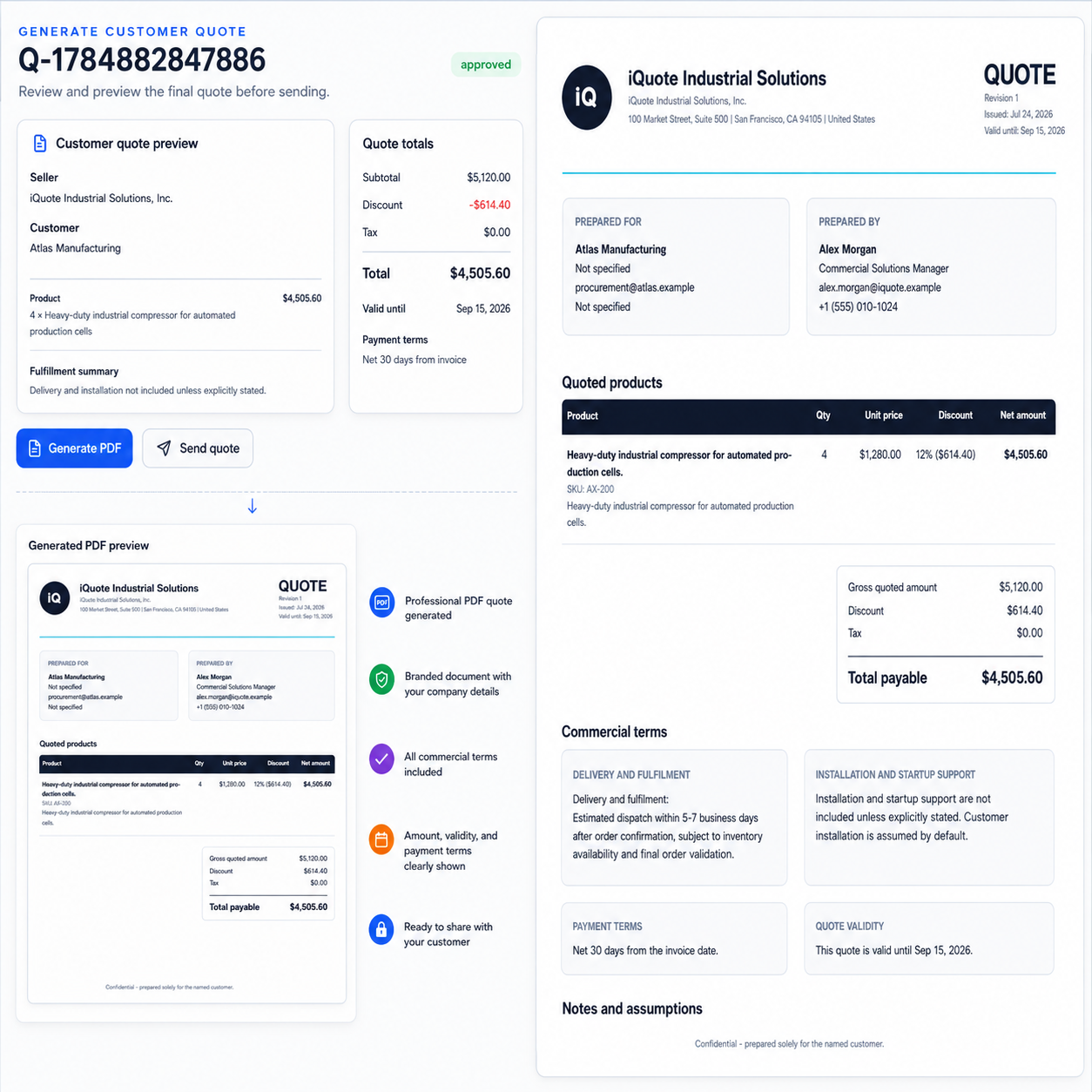
Generate customer-facing output only from approved state
The final document contains approved products, quantities, prices, terms, validity and delivery assumptions.
Internal economics, workflow reasoning and approval details remain outside the customer-safe PDF.
AI judgement boundary
The model proposes structure. The application controls commercial truth.
AI assists with
- Interpreting unstructured customer requests
- Extracting explicitly stated facts with confidence
- Identifying missing or ambiguous information
- Ranking known catalogue candidates
Deterministic services and people control
- SKU and catalogue truth
- Inventory availability and fulfilment
- Pricing, discounts, margin and totals
- Approval authority, quote status and customer terms
Timeouts, malformed output or incomplete extraction return the quote to manual review without losing the workflow state.
Key product and technical decisions
Three choices that shape the system
Exception resolution over chat
The product experience is organised around quote readiness, unresolved issues and approval—not open-ended conversation.
Typed extraction boundary
Model output is normalised and reviewed before catalogue, inventory and pricing services use it.
Approved-state output
The customer document is rendered from persisted, approved quote state rather than direct model output.
Reproducible scenarios
The workflow is tested through normal and exception paths
Straight-through quote
System response: Product, inventory, pricing and policy resolve normally.
Outcome: The quote becomes ready for review and customer output.
Discount approval
System response: A discount above policy creates delegated approval.
Outcome: The approver can accept, edit or reject before generation.
Inventory exception
System response: Insufficient stock blocks readiness and surfaces supported fulfilment options.
Outcome: A human confirms the resolution before the quote proceeds.
Architecture and implementation
A modular monolith for V1 speed with replaceable integration boundaries
The current implementation keeps UI, server actions, workflow services, rules, persistence and PDF generation inside a Next.js application. Supabase persists customers, products, prices, inventory, quotes, approvals and workflow events. OpenAI is isolated behind an extraction adapter.
Current architecture
Integration path
- Replace seeded customer and opportunity data with a CRM adapter.
- Replace seeded catalogue, pricing and inventory with ERP or CPQ adapters.
- Add production identity, RBAC, secure logging and telemetry.
- Run controlled dry-runs before expanding catalogue and policy coverage.
Expected value and project maturity
Built to validate workflow control before enterprise integration
Expected business value
- Reduce repetitive translation of quote requests.
- Surface missing information and exceptions earlier.
- Protect pricing and inventory from model-generated assumptions.
- Make approvals visible and auditable.
- Create a repeatable intake-to-output workflow.
What this demonstrates
- Translating an ambiguous operating process into a working application.
- Deciding where AI should and should not be used.
- Designing exception, approval and safe-failure paths.
- Combining product judgement with hands-on implementation.
- Building for inspectability, testing and customer-safe output.
Project status and credibility boundary
Implemented: request intake, structured extraction, rep corrections, catalogue and fulfilment resolution, seeded pricing and policy, deterministic calculations, approval routing, PDF generation, mock delivery and automated scenario paths.
Not presented as production: live CRM/ERP integration, production RBAC, real email delivery, broad catalogue coverage, enterprise-scale security and verified customer outcome metrics.
A production pilot would add identity and permissions, secure logging, telemetry, real system adapters, evaluation, operational monitoring and a measured set of dry-runs.
Relevant to finance, procurement and commercial operations
Building an AI workflow where business rules and human judgement must stay in control?
I’m interested in roles and projects where ambiguous operational work needs to become a reliable, inspectable and human-controlled AI system.