Insight Journal | Structured AI Workflow Product
A personal product build that turns unstructured reflection into persistent, explainable feedback
Evidence type: Personal product and build, not client work.

Workflow-product relevance
- Workflow problem: Free-form journal entries require effort but do not naturally produce structured feedback or visible patterns.
- Input: Unstructured journal text.
- Structured extraction: Mood, stress, energy, and themes are extracted as numerical and categorical fields.
- Persistence and retrieval: Raw entries, structured signals, and text embeddings are stored so the system can retrieve similar context and detect recurrence over time.
- Logic separation: Deterministic rolling aggregation handles measurable trends; embedding similarity and probabilistic synthesis handle contextual patterns.
- Explainability and trust: Numerical aggregation grounds the insight, while the interface includes structured insight cards and a clear “Not Enough Data” state instead of forcing a conclusion.
- User feedback loop: The MVP is designed to test which insights users find useful and where the response creates confusion.
1. The Problem
Journaling is widely recommended for self-improvement, yet consistency drops off quickly.
Through observation and first-principles thinking, I identified the root issue:
Journaling requires high emotional effort but produces no visible return.
Most apps store text.
They don’t convert reflection into feedback, trends, or measurable growth.
This creates a value gap:
High cognitive effort → Low perceived output → Low retention.
The opportunity was to redesign journaling around structured insight generation, not text storage.
2. The Hypothesis
If journaling produces structured, explainable insights that show users measurable growth patterns, then consistency and engagement will increase.
So instead of building a journaling app, I built an insight engine layered on top of journaling behavior.
3. Product Strategy
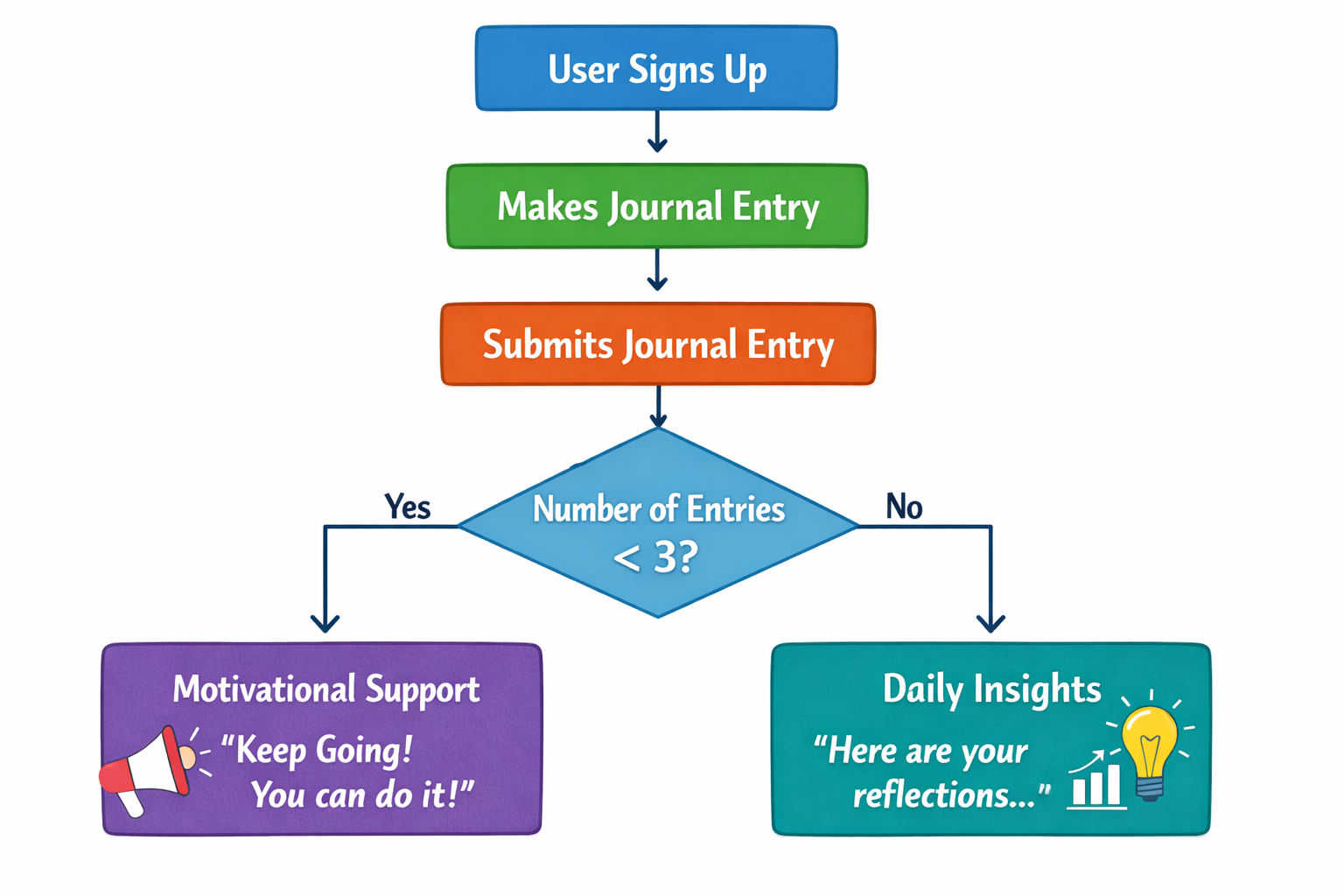
I constrained the MVP around one core loop:
Write → Extract Signals → Detect Patterns → Deliver Insight
No dashboards.
No gamification.
No habit streak counters.
No feature sprawl.
The only value proposition:
“Write once. Get intelligence back.”
4. System Design Thinking
The key architectural decision was separating the AI pipeline into two parallel tracks.
Most AI journaling tools rely entirely on generative summaries.
That approach is opaque and difficult to scale into measurable analytics.
I instead designed a hybrid system:
Track 1: Deterministic Signal Layer
Each journal entry is processed to extract structured signals:
- Mood
- Stress
- Energy
- Themes
These are stored as numerical and categorical fields.
This allows rolling 3-day aggregation to detect measurable changes.
Track 2: Semantic Memory Layer
Each entry is also converted into a text embedding.
This enables:
- Similarity detection
- Pattern recurrence
- Clustering of emotional themes over time
The final daily insight synthesizes both tracks.
Deterministic aggregation provides measurable trend detection.
Embedding similarity provides contextual memory and pattern awareness.
This separation improves interpretability, reduces hallucination risk, and creates a scalable intelligence foundation.
5. Architecture & Execution
I intentionally optimized for velocity and clarity.
Frontend
- Built in Next.js
- Hosted on Vercel
Backend & Database
- Authentication and data storage via Supabase
- Row-level security for strict user isolation
AI Layer
- Signal extraction (structured outputs)
- Embedding generation (semantic vectors)
No premature optimization.
No overbuilt analytics infrastructure.
The MVP validates the behavioral loop before investing in scale.
6. UX Philosophy
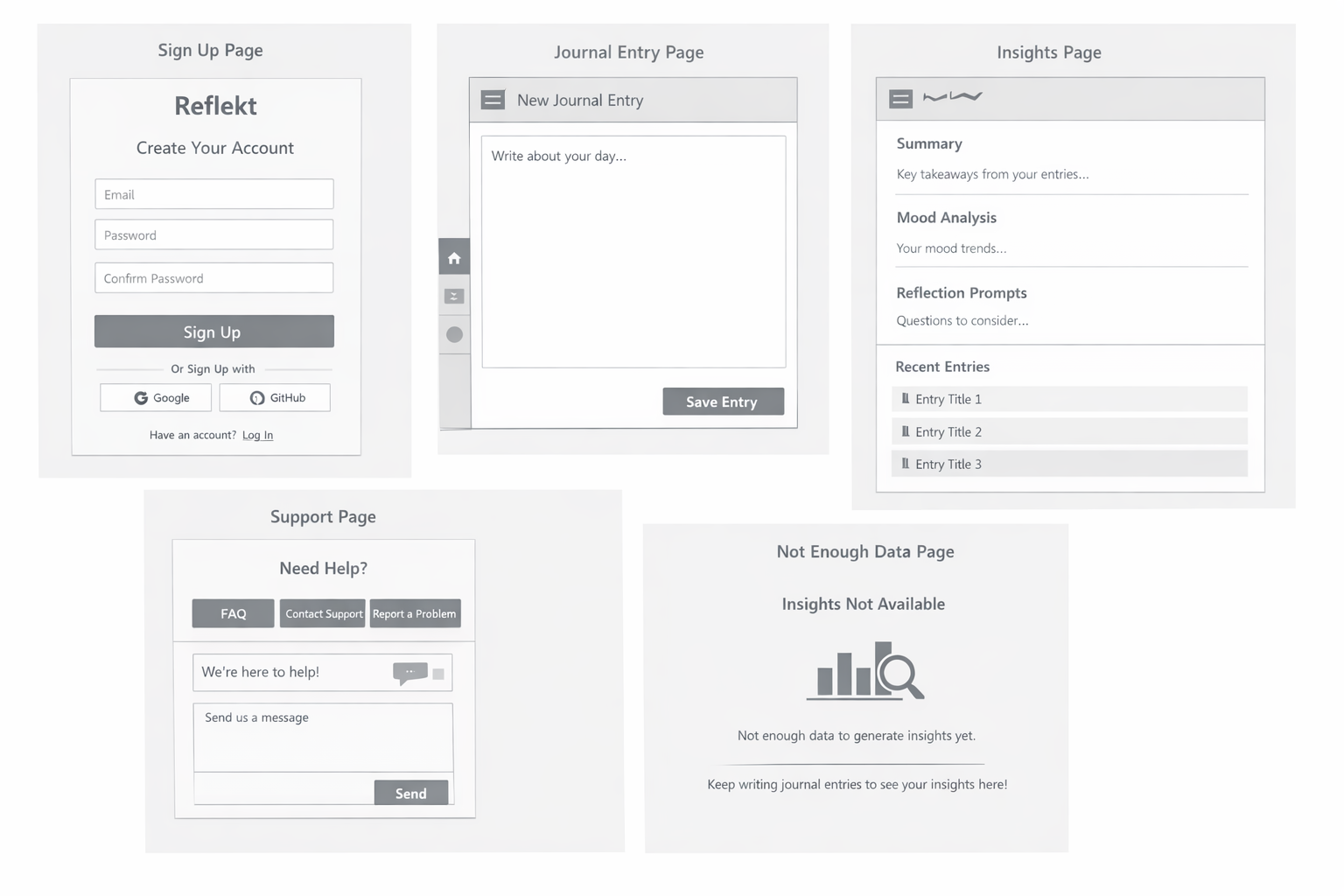
The UI was designed to reduce emotional friction:
- Distraction-free writing interface
- Structured insights presented as cards
- Clear “Not Enough Data” state to reinforce streak-building
The interface is intentionally minimal.
If insight generation is the product, the UI should not compete with it.
7. Product Trade-offs
What I explicitly did not build:
- Long-term dashboards
- Habit gamification
- Multi-model personalization
- Automated coaching agents
These are expansion vectors, not MVP requirements.
The focus was validating:
Does structured feedback increase journaling consistency?
8. What This Demonstrates
This project highlights several PM competencies:
- Behavioral problem decomposition
- AI system architecture design
- Clear separation of deterministic vs probabilistic logic
- Data modeling discipline
- Scope control under uncertainty
- Building for explainability over novelty
Most importantly, it shows how to convert an abstract emotional behavior into a measurable system.
For B2B SaaS teams, the transferable pattern is the architecture of the workflow: convert unstructured input into persistent structured state, keep deterministic and probabilistic logic separate, retrieve relevant context, explain why an output was produced, and use user feedback to evaluate usefulness.
9. Future Expansion
The architecture now supports:
- Long-term behavioral trend modeling
- Emotional volatility scoring
- Cognitive bias detection
- Personalized reflective coaching agents
- Semantic memory graphs
Because the foundation was structured correctly, the system scales without re-architecture.
For a deeper dive into this project please check below:
Insight Journal - Product deep dive
Apply the workflow pattern
Discuss a structured AI workflow prototype.
Start with the unstructured inputs, the state that needs to persist, the decision or feedback the product should support, and the human-review model.
Book Free Review