Why AI Accuracy Metrics Can Mislead Product Teams
92% Accurate. 100% Confident. 0% Useful.
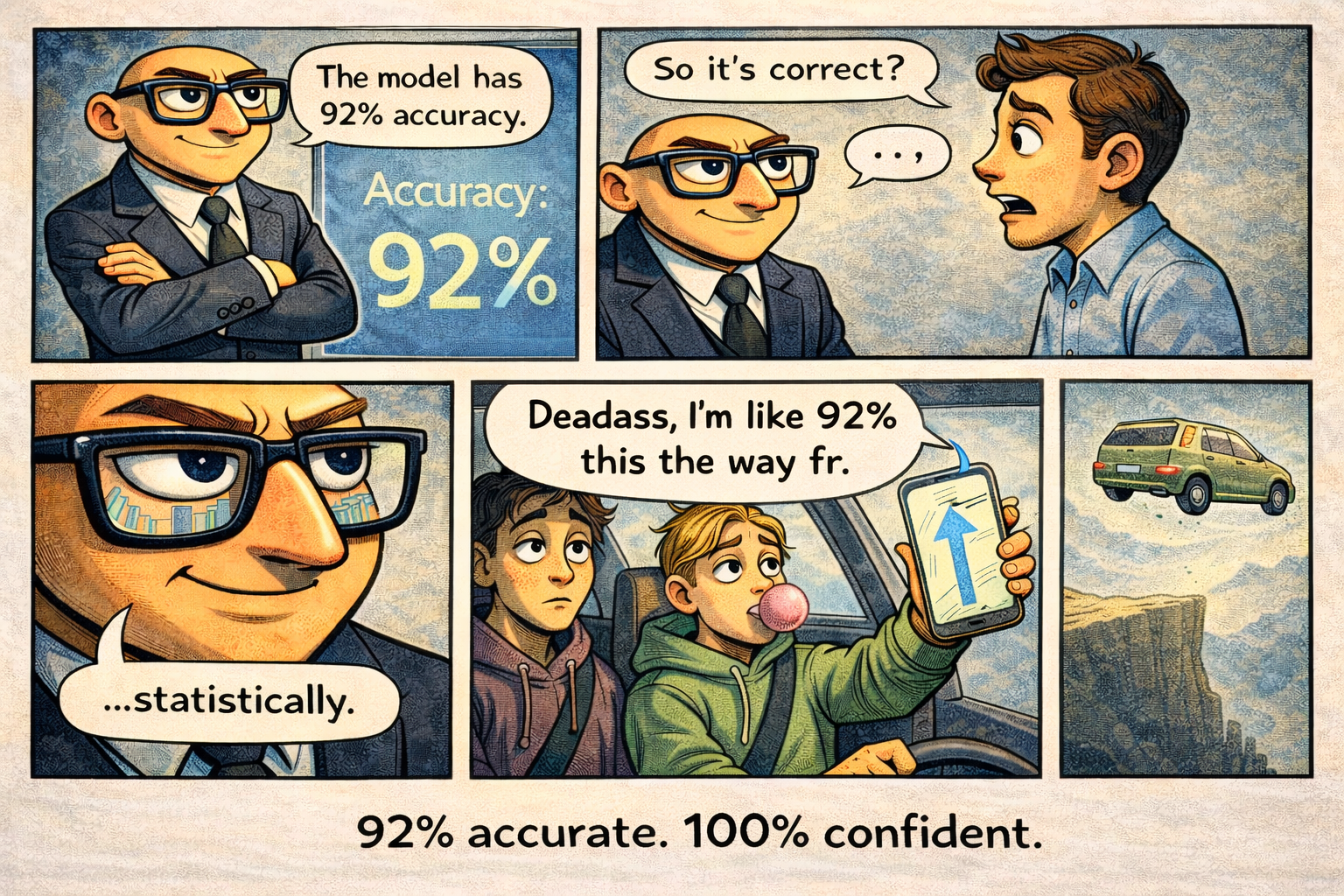
AI product demos often begin with a reassuring slide:
“Our model has 92% accuracy.”
It sounds impressive. It signals technical progress. It suggests the system is reliable enough to ship.
But here’s the uncomfortable truth: accuracy alone rarely tells you whether an AI product is safe, useful, or trustworthy.
As product managers, our job isn’t to ship models that perform well on evaluation datasets. Our job is to ship systems that behave reliably in the messy reality of user environments. And that’s where accuracy metrics can become dangerously misleading.
Accuracy Is an Average. Users Experience Failures.
Accuracy compresses model behavior into a single number. But real-world usage doesn’t happen as an average.
Users experience individual predictions.
If a navigation system claims 92% accuracy, that means 8 out of 100 decisions could be wrong. In low-stakes scenarios, that might be acceptable. But if those failures occur at critical moments, the consequences can be severe.
The key question isn’t:
“How accurate is the model?”
It’s:
“What happens when the model is wrong?”
A product that fails gracefully can still earn user trust. A product that fails catastrophically—even rarely—cannot.
Benchmark Metrics Hide Real-World Complexity
Many AI teams optimize models against clean evaluation benchmarks. These datasets are curated, labeled, and often represent idealized scenarios.
But production environments introduce variables that benchmarks rarely capture:
- edge cases in user input
- ambiguous or incomplete data
- unexpected workflows
- adversarial or creative user behavior
A model that performs exceptionally in controlled testing may behave unpredictably when exposed to the long tail of real-world interactions.
This gap between offline performance and real-world reliability is where many AI products struggle.
The Metric Trap in AI Product Development
Overemphasizing accuracy can create a subtle but powerful trap in product development.
When teams rally around a single metric, progress becomes defined as incrementally improving that number. The model goes from 88% to 90% to 92%, and it feels like steady advancement.
But the underlying product risks may remain unchanged.
A model with slightly higher accuracy might still:
- fail on the same edge cases
- produce confident but incorrect outputs
- mislead users who trust its authority
In other words, the metric improves while the user experience stays fragile.
What Product Managers Should Actually Ask
Instead of focusing exclusively on accuracy, product leaders should push teams to explore deeper questions about system behavior.
Some of the most valuable questions include:
Where does the model fail most often? Patterns of failure reveal much more than overall accuracy.
How severe are those failures? Some mistakes are harmless; others break the product experience.
Can users detect when the model is wrong? Invisible errors are far more dangerous than obvious ones.
What recovery paths exist? A resilient product allows users to correct or override the system.
These questions shift the conversation from model performance to system reliability.
Designing for Failure, Not Just Accuracy
Every AI system will fail occasionally. The goal of product design is not to eliminate failure entirely—it’s to control how failure impacts the user experience.
Strong AI products often include safeguards such as:
- confidence thresholds before automation
- human review loops
- fallback systems
- transparent explanations
- user override mechanisms
These features don’t necessarily increase model accuracy. But they dramatically improve product trustworthiness.
The Metric That Actually Matters: Trust
In the long run, users evaluate AI products based on a simple question:
“Can I trust this system?”
Trust isn’t determined by benchmark scores. It emerges from consistent, predictable behavior over time.
A system that is 92% accurate but fails unpredictably will erode trust quickly.
A system that is slightly less accurate but reliably handles errors and edge cases can become indispensable.
This is why mature AI product teams treat model metrics as inputs to product decisions—not the product outcome itself.
Final Thought
Accuracy metrics are useful. They provide signals about model improvement and help guide experimentation.
But when building AI products, metrics should inform judgment—not replace it.
Because in the end, users don’t experience accuracy percentages.
They experience whether the product works when it matters.
AI Workflow Audit
Want to apply this to your workflow?
I help B2B teams design human-approved AI workflow systems for CRM hygiene, lead research, content ops, and internal automation.
Book Free Review