The North Star Metric in AI-Driven Product Development
Why the brightest metric in the sky still won’t steer the ship
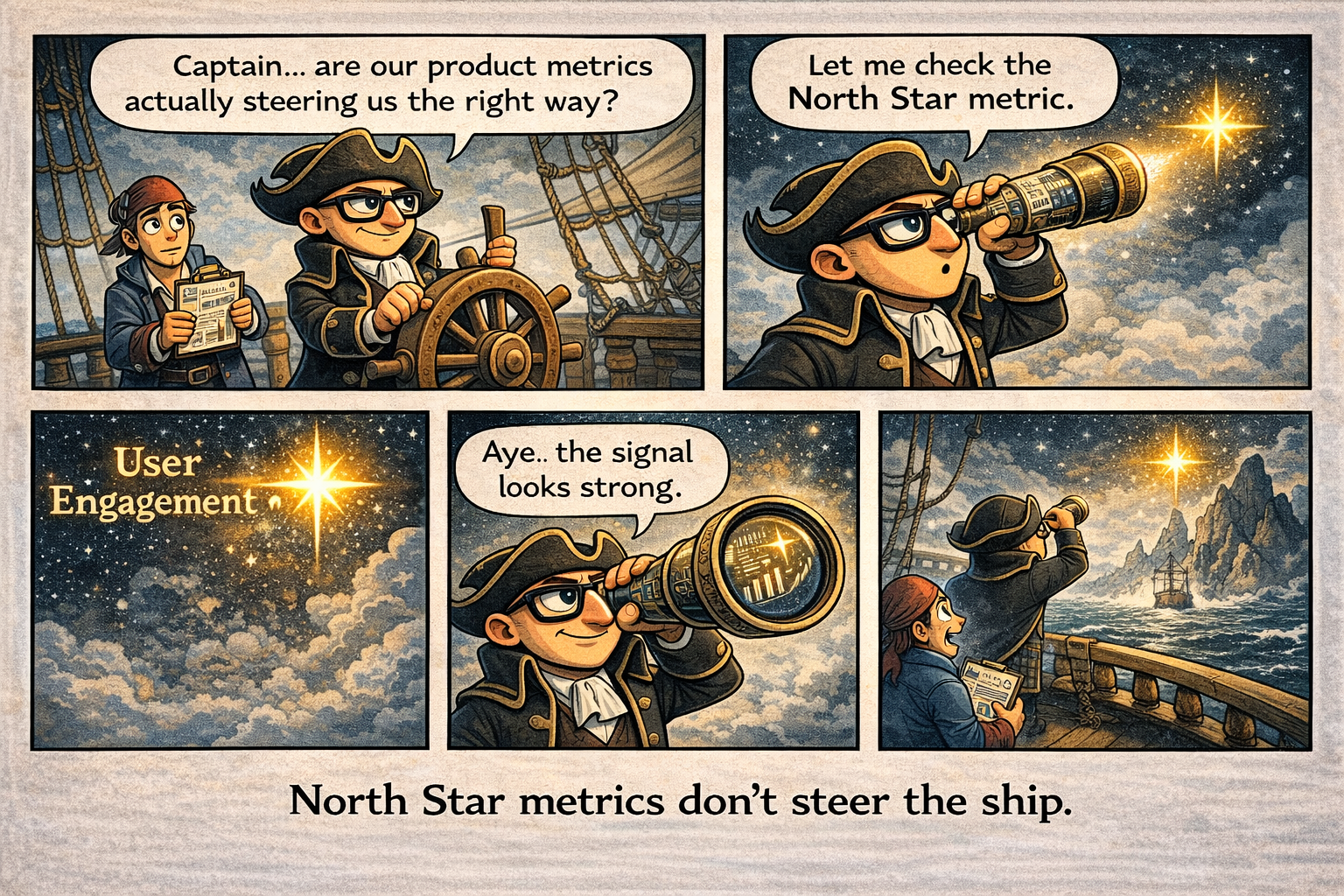
In product management folklore, the North Star Metric (NSM) holds a near-mythical status. It promises alignment, clarity, and focus — a single guiding light that tells the entire organization whether the product is truly delivering value.
In theory, it’s elegant.
In practice, it’s often misunderstood.
Especially in AI-driven products, where metrics can look impressive while the underlying product reality quietly drifts off course.
Let’s unpack why.
The Original Idea Behind the North Star
The concept of a North Star Metric was popularized to solve a coordination problem inside product organizations. Teams often optimize for their own local metrics:
- Growth teams optimize acquisition
- Data teams optimize model accuracy
- Engineering optimizes performance
- Marketing optimizes engagement
The result? A product that improves everywhere — except in the one place that matters: user value.
A North Star metric attempts to unify the organization around a single measurable signal that represents the value users receive from the product.
Examples often cited include:
- Ride-sharing: Completed rides
- Marketplaces: Successful transactions
- Collaboration tools: Active collaborative sessions
In short:
The North Star metric measures value delivered, not activity generated.
Where AI Products Complicate the Story
AI products introduce a subtle but dangerous twist.
They generate highly measurable signals — accuracy, recall, precision, engagement, completion rates, recommendation clicks.
These numbers often look scientific and trustworthy. Dashboards glow green.
But they can create an illusion of progress.
An AI product can simultaneously show:
- 92% model accuracy
- Rising engagement
- Increasing feature usage
…while the actual user problem remains unsolved.
Why?
Because AI systems often optimize for predictive performance, not human usefulness.
The model might be getting better at predicting something.
But that doesn’t guarantee it’s predicting the thing that matters.
The Metric Telescope Problem
Product teams often treat their North Star like an observational instrument.
They point their analytics stack at a particular signal — say, user engagement — and watch it closely.
If the signal grows brighter, confidence grows with it.
But the act of observing a signal doesn’t guarantee it represents the right direction.
A metric can appear strong because:
- The system encourages behavior that inflates it
- The metric captures activity rather than value
- The product makes something easier to do, not worth doing
In AI products, this happens frequently.
Recommendation systems boost click-through rates.
Writing assistants increase generated text volume.
Analytics copilots produce more queries.
Yet none of these automatically translate to better decisions, better outcomes, or meaningful user success.
The signal shines.
But the course may still be wrong.
AI Teams Often Optimize the Wrong Layer
Another trap emerges in AI organizations: metric displacement.
Instead of optimizing the product outcome, teams optimize the model layer.
Examples:
| What teams optimize | What actually matters |
|---|---|
| Model accuracy | Decision quality |
| Prediction latency | User trust |
| Recommendation CTR | Long-term satisfaction |
| Prompt completion rate | User problem solved |
The difference seems subtle.
But it fundamentally changes product direction.
A model improvement that increases accuracy by 3% might have zero effect on user outcomes.
Meanwhile, a seemingly small UX change — like surfacing model uncertainty — might dramatically improve user trust and decision quality.
The North Star metric should capture the latter, not the former.
The Engagement Illusion
Engagement metrics are particularly seductive in AI products.
Why?
Because AI systems often create frictionless interaction loops:
- Chat interfaces
- Infinite recommendations
- Auto-generated outputs
- Predictive suggestions
These systems are designed to keep users interacting.
Which means engagement often grows automatically — even when the product isn’t meaningfully improving the user’s life.
Engagement can increase because:
- AI makes experimentation easy
- Users are exploring novelty
- Outputs are entertaining but not useful
Without careful interpretation, engagement becomes a false North Star.
It measures motion, not progress.
The Reality of Navigation: Strategy Requires Detours
Even when a team identifies the right North Star metric, the path toward it is rarely a straight line.
Real products encounter obstacles:
- Model limitations that prevent reliable outputs
- Data sparsity or bias that affects prediction quality
- User trust gaps when AI behaves unpredictably
- Regulatory or ethical constraints around automated decisions
- Operational scaling challenges as usage grows
These challenges often require strategic pivots or temporary detours.
This is where the metaphor of navigation becomes useful.
A navigator does not sail directly toward a star.
Wind patterns, currents, reefs, and storms force adjustments.
Similarly, product teams must sometimes move sideways or even backward in the short term to move toward the long-term direction indicated by the North Star.
Examples include:
1. Prioritizing trust before intelligence
An AI assistant might need features like:
- confidence indicators
- explanation layers
- human verification loops
Even if these features temporarily slow engagement growth, they may be essential for long-term adoption.
2. Simplifying the product before expanding capabilities
Teams often discover that improving the North Star metric requires removing complexity, not adding features.
This can mean:
- narrowing the use case
- removing underused AI capabilities
- focusing on one high-value workflow
The result can appear like a retreat — but it’s often the most direct route toward real value.
3. Investing in infrastructure before user-facing features
Sometimes progress toward the North Star requires work that users never see:
- better training pipelines
- improved evaluation frameworks
- safer deployment architecture
- stronger feedback loops
These investments may not move the headline metric immediately, but they enable sustainable movement toward it.
The Real Role of a North Star
The North Star metric is not a steering mechanism.
It’s a navigation reference.
It helps answer a simple but profound question:
If this number grows, are users genuinely better off?
If the answer is uncertain, the metric is probably not your North Star.
And even when the metric is correct, the path toward it requires continuous interpretation and course correction.
Metrics indicate direction.
Strategy determines how to travel there.
The Quiet Discipline of Good Product Leadership
A good AI product organization treats metrics with a healthy skepticism.
Numbers are valuable.
But they are not reality — they are representations of reality.
The discipline lies in constantly asking:
- What behavior is this metric rewarding?
- What user outcome does it truly represent?
- Could it grow while user value declines?
- Are we moving toward it in the most meaningful way?
Because the danger is not that teams ignore metrics.
The danger is that they trust them too easily.
Final Thought
In the night sky of product analytics, some signals shine brightly.
But brightness alone does not guarantee direction.
A North Star metric can help teams orient themselves.
Yet progress toward it rarely happens in a straight line.
Storms appear. Currents shift. Unexpected obstacles emerge.
And sometimes, the most strategic move is not to go directly toward the signal — but to adjust the route so the journey can continue.
Because the North Star can guide the direction.
But it still takes judgment, strategy, and leadership to steer the ship. 🚢✨
AI Workflow Audit
Want to apply this to your workflow?
I help B2B teams design human-approved AI workflow systems for CRM hygiene, lead research, content ops, and internal automation.
Book Free Review