Data-Driven vs Driven by Data: A Critical Distinction for AI Product Managers
Data Should Guide Product Strategy — Not Drive It Blindly.
Introduction
In modern product teams, dashboards glow brighter than Christmas trees.
Accuracy metrics. Retention graphs. Query counts. Engagement funnels. AI confidence scores.
Every meeting starts with a chart.
And yet, paradoxically, many AI products still fail to deliver meaningful value.
This raises an uncomfortable question:
If we have more data than ever, why do we still make bad product decisions?
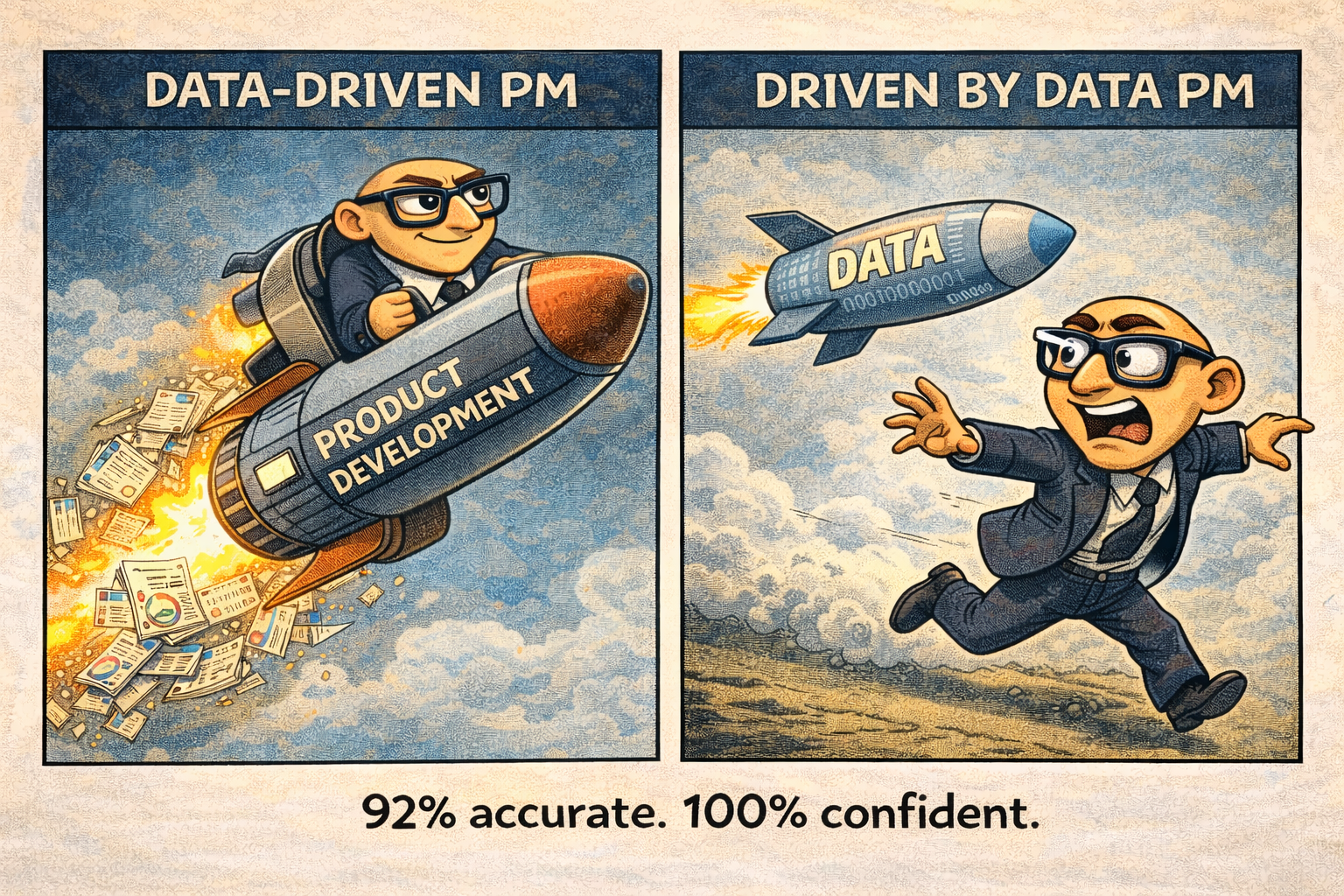
The answer often lies in a subtle but critical misunderstanding. Many teams proudly claim to be data-driven, when in reality they are driven by data.
The difference sounds semantic.
It is not.
For AI product managers, this distinction can determine whether your product becomes a strategically guided system that solves real problems, or merely a machine optimized to improve metrics.
Core Explanation: Data-Driven vs Driven by Data
At first glance, both phrases appear identical. But their implications for product management are dramatically different.
A useful way to think about this is to separate how data influences decisions.
Data-Driven Decisions
A data-driven decision is one where data directly determines the outcome.
These decisions typically occur when:
- The question is well defined
- The metric clearly measures success
- An experiment provides a clear answer
In such cases, data acts as a decisive signal.
Example
Suppose you run an A/B test for two onboarding screens:
| Variant | Conversion Rate |
|---|---|
| A | 41% |
| B | 47% |
Variant B performs better.
No philosophical debate required. The data speaks clearly.
This is the ideal context for data-driven product decisions.
Data-Informed Decisions
However, most important product decisions do not occur in such controlled conditions.
This is where data-informed decision making becomes essential.
A data-informed decision combines data with other strategic inputs such as:
- Product vision
- User research
- Market context
- Business strategy
- Technical feasibility
In this scenario, data does not dictate the answer. Instead, it informs the judgment of the product team.
Example
Imagine deciding whether to build an AI assistant feature.
Data might show:
- Moderate user demand
- High engineering complexity
- Strategic importance for future product positioning
The decision must balance multiple dimensions:
- User value
- Strategic differentiation
- Development cost
- Long-term vision
This is where product management stops being mechanical and becomes strategic thinking.
The Third Category: Driven by Data
Problems arise when teams misunderstand the role of data.
Instead of using data as input, they treat it as authority.
This creates a dangerous anti-pattern: Driven by Data.
In this scenario:
- Metrics dictate priorities
- Model outputs drive product direction
- Dashboards replace strategic thinking
The product manager becomes less of a strategist and more of a metric interpreter.
Ironically, this often leads to worse products.
Why AI Products Are Especially Vulnerable
AI products amplify this problem because they generate an overwhelming number of metrics.
Teams track:
- Model accuracy
- Precision and recall
- Hallucination rates
- Latency
- Query counts
- User engagement
- Token usage
These numbers create the illusion of precision.
But many of them are proxy metrics, not direct measures of user value.
And proxy metrics can be dangerously misleading.
Accuracy Does Not Equal Usefulness
An AI chatbot might achieve 92% accuracy in answering questions.
But users may still find it useless if:
- Answers are technically correct but impractical
- Responses lack context
- The system fails to understand intent
The model performs well.
The product fails.
Insightful Analysis: The Dashboard Illusion
The deeper issue is psychological.
Metrics create a comforting illusion of control.
Numbers appear objective. Charts feel authoritative. Data seems neutral.
But in reality, metrics always represent simplified proxies for complex human outcomes.
For example:
| Metric | What It Appears to Measure | What It May Actually Mean |
|---|---|---|
| Engagement time | User interest | User confusion |
| Query count | Product adoption | Users retrying failed queries |
| Accuracy | System reliability | Surface correctness without usefulness |
This phenomenon creates what might be called the dashboard illusion.
The product looks healthy in analytics tools while users quietly struggle.
Illustrative Examples
Example 1: The AI Customer Support Bot
A support chatbot reports:
- 94% answer accuracy
- Reduced response time
- Increased chatbot usage
Yet customer satisfaction declines.
Why?
Because the bot provides correct information but fails to:
- resolve issues
- escalate complex cases
- provide actionable guidance
The system optimizes accuracy, while users care about resolution.
Example 2: The AI Tutor
An AI tutoring product shows declining session duration.
A metric-driven team panics.
But deeper analysis reveals something surprising:
Students are solving problems faster.
Learning efficiency improved.
The metric looked worse, but the outcome improved.
A data-informed PM investigates outcomes.
A driven-by-data team chases the metric.
Frameworks for AI Product Decision Making
To avoid metric traps, AI product managers can use a three-layer decision framework.
Layer 1: Model Metrics
These measure the technical performance of AI systems.
Examples:
- Accuracy
- Precision and recall
- Latency
- Hallucination rate
Important for engineering quality—but insufficient for product success.
Layer 2: Product Metrics
These measure how users interact with the product.
Examples:
- Task completion rate
- Feature adoption
- Retention
- Time to resolution
These metrics connect the AI system to product behavior.
Layer 3: Outcome Metrics
These measure real user value.
Examples:
- Did the user solve their problem?
- Did productivity improve?
- Did the workflow become easier?
Outcome metrics represent the true north star.
Everything else is supporting evidence.
A Simple Mental Model
One way to visualize the difference between the two approaches:
Data-Driven PM
Uses data as a compass.
Driven-by-Data PM
Uses data as autopilot.
A compass guides direction.
Autopilot assumes the destination is already correct.
Great product managers know that choosing the destination is the real job.
Key Takeaways
- Data-driven decisions occur when data directly determines the outcome.
- Data-informed decisions combine data with strategic context.
- AI teams often fall into the trap of being driven by data, where metrics dictate decisions blindly.
- Many AI metrics measure system performance, not user value.
- Product success depends on outcome metrics, not just model metrics.
- The best AI PMs treat data as guidance, not authority.
Conclusion
Data has transformed product management.
But data alone cannot replace judgment.
The most successful AI products are not built by teams that worship dashboards.
They are built by teams that interpret data through the lens of strategy, user understanding, and product vision.
Because ultimately, data can tell us what is happening.
It cannot tell us what should exist.
That responsibility still belongs to product managers.
And the difference between being data-driven and driven by data is where true product leadership begins.
Sources
- https://gopractice.io/data/data-driven-data-informed-data-inspired/
- https://supermetrics.com/blog/data-driven-vs-data-informed
Notes
A good product manager makes key product strategy decisions that are both data driven and data informed.
- Data-driven decisions occur when data directly determines a clear measurable outcome.
- Data-informed decisions occur when data is used alongside product strategy, user research, market conditions, and business context.
In the context of AI product management, relying purely on data-driven signals without incorporating broader strategic context often leads to driven-by-data decisions.
In such cases:
- Metrics dictate priorities
- Model outputs drive product direction
- Decisions become reactive rather than strategic
This ultimately leads to product teams optimizing dashboards rather than solving real user problems.
AI Workflow Audit
Want to apply this to your workflow?
I help B2B teams design human-approved AI workflow systems for CRM hygiene, lead research, content ops, and internal automation.
Book Free Review